Showing posts with label Architecture. Show all posts

Tuesday, August 20, 2013

Travelogue, et cetera - Of Apples and Oranges, Peaches, Donuts, Caves, and Kindness

To this place, and the kindness of these people, I owe everything.

- Abraham Lincoln, Farewell Address at Springfield, Illinois - February 11, 1861

It's been a varied and busy last month or so. This has been more interesting than usual because of all the places we've been over that time frame.

We had the 9-year-old son of Leslie's best friend with us for a week in July. We went bicycling in North Park and swimming at the Sewickley Community Center - activities that were simple, low cost, and a lot of fun.

Penns Cave Hotel
The old hotel at Penn's Cave, Centre Hall, Pa.

We then took Aaron home to New York, and on the way experienced Penn's Cave in rural Centre County. Aside from the cave itself, which is intensely interesting, the wildlife park, original 19th century hotel, and meticulously maintained grounds were also impressive. The money and time for this visit were well spent.

On the way back, Leslie and I enjoyed breakfast at a favorite diner, and then spent some time at an outlet mall in Tannersville, Pa., which is about 10 miles from Ross Township in Monroe County. This was the scene of a shooting at a municipal meeting on August 5 that left three dead and several wounded. This included the shooter, who sought revenge for losing his property to condemnation, the culmination of a local dispute that reportedly lasted over 20 years.

This incident generated some discussion locally about security at municipal buildings, including here in Leetsdale. Borough council seemed concerned primarily with day-to-day access to borough offices, which while a valid concern didn't seem to me to pose the greatest overall threat.

LeetsdaleBoroBldg Exterior
Leetsdale Borough Building - Council Chambers as seen from Beaver Street. Credit - Google Maps

As the attached photos illustrate, the entire council chamber is both proximal and visible to anyone walking or driving by on Beaver Street. I'm wondering how something like that would be viewed by someone doing a professional threat assessment, and what their recommendations might be. Consider that the Monroe County suspect began his rampage by shooting through the walls.

Interior of Leetsdale Council Chambers. Council and other officials sit facing the exterior windows.
 
Credit - Sewickley Patch

Prior to this, Leetsdale also made news for proceeding to advertise for the hiring of a Borough Manager, which on the surface runs counter to what the majority of council seemed to advocate when they were elected in 2011, and also when they summarily eliminated the position upon taking office in January 2012.

I congratulate Leetsdale Council for apparently recognizing the need for day-to-day, professional municipal management, and acting in a responsible way to fill the position. I say 'responsible' because they are engaging independent, professional assistance to conduct the recruitment.

At the end of July we were once again on the road, this time back to Colorado for the first time in over 2 years. While we spent a good amount of time there visiting with my son, the trip wasn't long enough, especially in relationship to other things we did along the way. While they didn't take an extraordinary amount of time (and yet were very worthwhile), they did eat into our travel goals to the point that it took a good couple of days to recover after we got back - between work shifts, that is.

Both before our departure and after our return, the topic of property tax reassessment appeared in the news again. First, the Tribune-Review reported on July 30 that Allegheny County was returning to a base-year system of doing tax assessments, perhaps headed down the same road that got them sued several years ago. Then this past Wednesday, the Trib reported on Washington County's plans to abide by a court order to re-assess...after 32 years.

The first Trib story pointed out a glaring observation about the archaic nature of taxation and governance in Pennsylvania - “There's no state law that requires periodic reassessments. Pennsylvania is one of a handful in the country that don't.

I resist making comparisons between Pennsylvania and Colorado - the differences in governance are too stark - but apples to oranges or not, it's gotta be said:

Colorado counties re-assess all property every odd-numbered year, as required by state law. Over the 10-plus years that I have owned property there, I've seen my assessed valuation, and along with it my taxes, fluctuate with the condition of the market and the economy over that time frame.

With the near-collapse of the housing market in 2008 came a significant reduction in the market value of the property, and a corresponding reduction in the tax rate after the 2009 reassessment. Essential government services were maintained, but a lot of the fat was cut out of municipal budgets, some layoffs occurred, and some necessary hiring and procurement was pushed back.

Government expanded and contracted with the times and the economy - what a concept. Admittedly though, a good many governments in Colorado don't have unionized employees. More evidence of the need for effective day-to-day management of municipal operations, including budgets and financial planning, in response to these factors.

This doesn't mean that a full-time manager is a guarantee that all will go smoothly. The Leetsdale manager will likely serve at the pleasure of the governing board of elected officials, as most other appointed municipal managers do.

When some of those elected officials engage in potentially questionable activities on their own, it may hinder the ability of a manager or administrator to do their job effectively. This was most recently illustrated by media reports of private meetings by the Cecil Township Supervisors with Range Resources, and by Moon Township Supervisors with Robert Morris University.

So we'll see how things pan out in Leetsdale. I'm cautiously optimistic.

Colorado and Pennsylvania do share a lot of common ground - big energy continues to loom as a threat to rural ways of life, including water, traffic, and development issues. My former next door neighbor, an energy worker and part-time writer, recently chronicled some of the more subtle, but no less significant, impacts of fracking on the human condition. His column made its way into the New York Times.
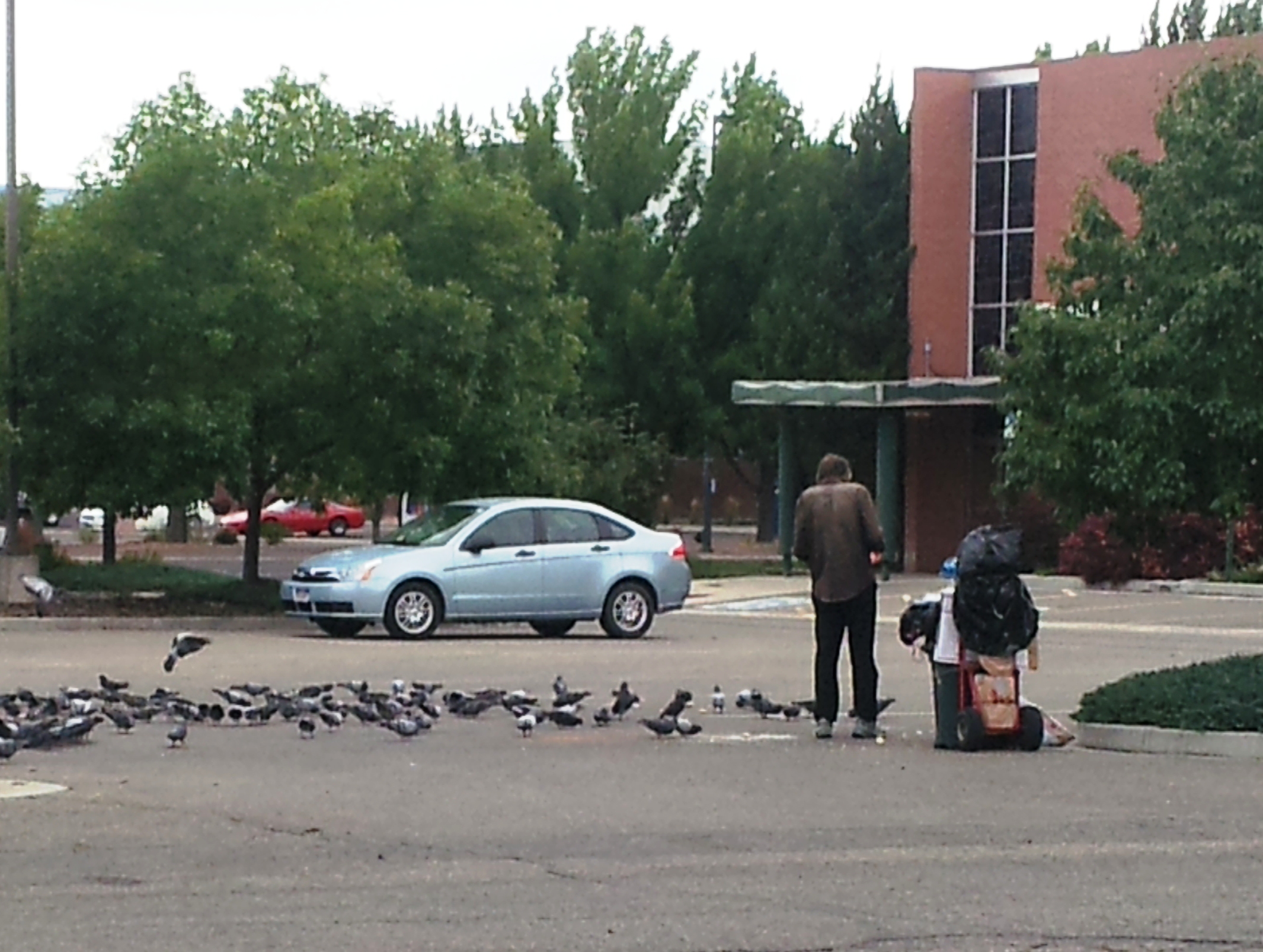
Birdman
Edward "The Birdman" Gillman makes his rounds through Downtown Grand Junction, Colorado, as he has for nearly 30 years.

Between hiking and a short trip to an excellent car museum, we saw a sign of hope and kindness while walking to dinner Downtown. One of the city's most eccentric, resilient citizens, whom I wrote about in 2010, was still actively plying his self-appointed trade.

Ball Fruit
Ball Fruit Stand, Palisade, Colorado

We found kindness in the eyes and smile of the woman at the family-owned bakery a few blocks from the house. The place has been in business for over 65 years, and I'm betting that the decor has hardly changed. The smells coming from inside the place while on a late night walk together was a harbinger of the genuine good will we found there the next day.

We found the same kindness from a Colorado woman welcoming us to her family fruit stand with a ripe peach for each of us. Leslie thought it particularly touching that she referred to us as a married couple - something that is an unfortunate rarity in some circles.

Carousel
 Gage Park Carousel, Topeka, Kansas

More good will came from the staff manning an antique carousel in a city park in Topeka, Kansas. The lady there took the time to speak with us about the carousel and its restored original wooden horses (which Leslie loves), and let me take a closer look at the working Wurlitzer Band Organ. We got to ride two other carousels on the trip - one in Abilene and another at an old amusement park outside of Denver.

We'll probably go back to Abilene for the preserved old west buildings, tourist railroad, and the Eisenhower Library, but also for the pleasant dispositions of the inhabitants. All except for the mosquitoes - they were something else entirely.

Dana Thomas
Dana-Thomas House, Springfield, Illinois - Built 1902

Just before our (literal) sprint home, we spent part of a day exploring some of the treasures of Springfield, Illinois. These included the home and tomb of Abraham Lincoln, and one of the finest examples of the early work of Frank Lloyd Wright.

We were able to see most of these while walking through the Downtown area. It was on the way back to our car, not far from the State Capitol building, that a young woman walking in the opposite direction looked at us and gave us one of the best memories of the entire trip.

She said, "You make a cute couple".

Sunset Russell KS
Near Russell, Kansas.
Have a great week ahead.

Friday, April 08, 2011

My Own Private Fallingwater

This is the front entry to my house in Grand Junction, Colorado. The cantilevered overhang has been deteriorating due to what appears to be moisture penetration. My friend Jeff is a handyman of some repute, so I asked him to take a look to see what happened and what needs to be done to fix it.

Jeff found that water had penetrated the exterior soffit of the overhang, but most of the supporting structure was intact. This did not prevent the overhang from deflecting downward about 2 inches - hence the hydraulic jacks and temporary support beams.

Over the last few weeks Jeff has been gradually raising the jacks to level the overhang, and will use long lag bolts to secure it back to its intended position. He's already replaced the rotted soffit. He's done some great work so far.

I was immediately reminded of the difficulties that plagued Fallingwater a little over 10 years ago. This is not entirely without coincidence, as the houses and their respective cantilevers were both constructed in 1936. As with many flat-roofed Wright buildings, leaks were always a problem - a consequence of Wright's designs outstripping the capabilities of the sealant technologies of the day.

Fallingwater had the additional issue of it's builders not compensating for the effect of time on the large, cantilevered terraces. Instead of constructing the wooden framework for the reinforced concrete with a slight upward angle to account for deflection in future years, the forms were built level. When they were struck, the new terraces were doomed to sag at an increasing rate, until the amount of deflection threatened their structural integrity. An expensive tensioning technique was used to gradually pull the terraces back up into the large rock that serves as an anchor for the entire house.

Other restoration work and upgrades were performed on the house from 2001 to 2003, including the re-pointing of some of the exterior walls and replacement of original windows with ultraviolet-resistant glass, in order to help preserve the woodwork and original, Wright-designed furnishings inside.

The problems with my overhang don't appear to be rooted in the original construction, but ironically to an improvement effort. Roughly 10 years ago I had the gutters replaced around the entire house. According to Jeff, there appears to have been metal flashing across the top of the overhang that would deflect water into the gutters on either side. This flashing was inexplicably removed, subjecting the bare wood underneath to the elements. Over time, water seepage from this removal appears to be the cause for the damage that we're mitigating now.

So while I'm getting settled back in the Pittsburgh area, some unwelcome settling back in Colorado is being handled in a manner not that different from that which helped to save one of America's most famous and revered houses and architectural landmarks.

As it happens, both my house and Fallingwater will turn 75 this year. The Western Pennsylvania Conservancy, which maintains and operates Fallingwater as part of a large nature preserve entrusted to them by the Kaufmann family, is planning several different events to commemorate this anniversary. I hope to be able to make it out to the house sometime this spring or summer. One goal I have when I get my life and schedule better regulated is to volunteer there. I've always wanted to be a guide or docent, and now I may have my chance.

Have a great day.


Photo Credit: pittsburgh.about.com (Fallingwater)

Thursday, October 21, 2010

The Guggenheim at 51


Today marks the 51st anniversary of the opening of the Solomon R. Guggenheim Museum in New York City, designed by Frank Lloyd Wright and opened six months after his death at the age of 91. There is a brief but excellent description of the history of the building in today's Writer's Almanac.

I visited the museum two years ago. As with many other Wright buildings, the Guggenheim is a space that has the ability to transform the senses, and in keeping with that spirit the museum has partnered with YouTube to sponsor and host a biennial festival of the best in creative online video, a medium that has had transforming effects on our society in the last decade. There is an impressive display of some of this video in the clip above. This evening YouTube will live stream the announcement of the best of those videos submitted for consideration.

It's not lost on me that the building is just a little older than I am; the commitment to embracing change, and showcasing the best of that change in celebration of both the medium and the messenger, is one way that the Guggenheim remains relevant to both society and the intentions of its namesake and its architect.

Have a good day.

Sunday, January 31, 2010

Earthquakes, Architecture, and Human Frailty

Tonight on CBS' 60 Minutes, Andy Rooney talked about his father's experience as a survivor of the 1923 Great Kantō earthquake in Tokyo. Rooney also showed some examples of photographs that his father took while in Japan, and made some comparisons of them to the recent calamity in Haiti.

Rooney also credited his father's staying in Tokyo's Imperial Hotel as a potential factor in his survival. In 1923 the Imperial had just been opened, and its architect, Frank Lloyd Wright, had designed the structure with specific features that, while not preventing some major damage, left the building largely intact.

The building was demolished in 1968, but a good portion of the lobby is preserved in a Japanese architecture museum. As was his usual practice with many clients, Wright not only designed the structure, but many of the interior components such as furniture, right down to the place settings.

Rooney has the unique ability to impart significant messages into what might otherwise be considered whimsy or nostalgia. You'll see what I mean.


Have a good start to the week.


Photo Credits: Wikipedia (Hotel exterior and interior)
The AMICA Library (place setting)

Tuesday, January 06, 2009

Winter Travelogue

Evan and I spent a full day last Friday exploring around Chicago, using the extensive train and subway system to make our way to several places of interest, including the top of the John Hancock Tower, seen at left (the one with the 'goalposts' on top).

The view is
spectacular, even if it's not the tallest building in town. We'll get to the Sears Tower the next time.

We walked all over the Loop area, t
hen hopped the train out to Oak Park, which has the largest concentration of Frank Lloyd Wright buildings anywhere. It's also the birthplace of Ernest Hemingway. They have a museum which I'm going to have to check out the next trip through.

Wright's first Home and Studio had all of its' tours sold out for the day, but there was one building that was within easy walking distance, which I had not been inside of before.

Unity Temple was designed by Wright for a Unitarian congregation who had lost their church to a fire. It was built in 1908 and 1909 for $60,000. The exterior is concrete with pea gravel for texture, which while not frequently used in construction 100 years ago was a less expensive alternative to stone.

The building is a short walk from the train station, and is open for self-guided tours. It is stately on the outside and an example of grace of simplicity on the i
nside.
Evan took this picture from the third level of what is a four level sq
uare sanctuary, with pews immediately in front of the altar and on 3 sides. The sanctuary seats 400, but no seat is further than 40 feet from the altar. The sanctuary is lit by stained glass windows on the sides as well as the skylights above.

Note the plastic and plywood
immediately above the organ loft. Significant roof damage was discovered in December, and the congregation is effecting emergency repairs. They've also established a restoration fund to make more permanent repairs, as well as make updates such as a new geothermal heating system. The light fixtures, stained glass, and some of the other furnishings are all of Wright's design.


The building is an open, welcoming, and comfortable space. It's difficult to grasp that it was designed and built over 100 years ago. I did my part in contributing to the restoration fund before departing.


Evan and I sometimes like to go to movies that are being shown in bigger cities, but not in Grand Junction. After an excellent lunch at a
small Mediterranean cafe right next to the movie house in Oak Park, we saw Milk starring Sean Penn. This was a very well done film that mixed archival footage from the day along with some strong performances to tell the story of the birth of political power within the gay community of San Francisco, and how it reverberated across the nation.

Speaking of Chicago and movies,
Roger Ebert got an entire 6 or 8 page section in last Friday's Sun-Times, filled with reviews of movies new and old. He's the best movie critic in the country, and I liked the movie section of the local paper so much I saved it as part of my trip scrapbook. From what I've read and seen so far, my next three movies are The Reader, Revolutionary Road, and Slumdog Millionaire, followed closely by Gran Torino. We'll likely get half of those movies here.

We returned to downtown Chicago and walked around some more. We wound up in the Theatre District, walking past the line of people waiting to get in to see
Wicked. We stopped inside Garrett Popcorn, which had an almost equal line of people. We got some Caramel Corn for my aunt Fran, then proceeded to try to locate some dinner.

We found some thanks to an app on Evan's IPhone called
Urbanspoon. It picked an Italian place not far from most of the theaters, and right next to the CTA Blue Line, which we needed to catch afterward to get back to Fran's house. Excellent main courses, and quite the dessert card.

I decided to come back to Grand Junction via
Amtrak, because it has been over 30 years since I rode the train anywhere overnight, and I've heard the views are breathtaking. Additionally, I thought I would enjoy the change of pace that this mode of travel offers, and neither Evan or I were disappointed.

The train left Chicago on time Saturday afternoon. The staff was professional, the food well prepared and ample. We had a sleeper for this trip, and it was nice to be able to use this kind of facility, but it also looked as though the regular coach seating was equal to the task, even for longer trips like the 27 hours it took to reach Grand Junction.


Evan and I passed the time by reading and watching movies on the laptop. Evan brought
The Darjeeling Limited because he liked it a lot, and thought we should watch a train movie on the train. I like Wes Anderson films, and this one didn't disappoint.

We slept across most of Nebraska, and pulled into Denver early Sunday morning. I parked myself in the sightseeing car for the bulk of the trip across the mountains. I met a very nice lady who lives in Whitewater and works for the Palisade Chamber of Commerce. Gabriela told me that she was returning from spending Christmas with her in-laws in Cleveland.


We had a good conversation about things Grand Junction as the train picked up the trail of the Colorado River and passed through Kremmling, Hot Sulphur Springs, and past a hippie-painted school bus parked next to 4 yurts at State Bridge.


My conversation with Gabriela led me to look up the
Palisade Chamber on the web; they've got a very informative, positive site filled with useful information on activities in the Palisade area, as well as local small businesses, including one that sells alternative energy products from an address in Palisade. It was nice to see that there are business and tourism promotional organizations that don't follow the lead of others in our area who seem to be divisive and exclusionary.

The entry into Glenwood Canyon began the last

portion of the journey, and we ended up pulling into Grand Junction a little early. The trip showed me that while rail service in this country is nowhere near what it is in many other parts of the world, it does remain a viable alternative for people who have the time to travel at a more leisurely pace, or don't want to deal with airports.

Yes, there are significant delays caused by many things, and perhaps we were more fortunate on this trip than many have been on others. I'd do it again, though.
With the new year upon us, there are many things to work on and many paths to consider.

May your path through this year and beyond be pleasant and uncomplicated, and may those challenges that put themselves in your way be something to exercise your God-given talents and learn more from, for that next stop down the road.


Have a good rest of the week.

Tuesday, August 26, 2008

Hospice - The Wright Stuff

On Sunday afternoon I attended the open house for the new Care Center of Hospice and Palliative Care of Western Colorado.

The building was magnificently planned and executed, and is designed to integrate fully with the existing Hospice building (the restored Miller Homestead), the Fairmount Health Park next door, and the surrounding neighborhood and assisted living communities nearby.

The building's exterior, looking from the main entrance, is reminiscent of other buildings designed by architects from local firm Blythe Design. Looking from the front hardly does the site justice, however, as the facility is exquisitely integrated into its' surroundings, and possesses noteworthy interior design features as well.

The building joins several in the Grand Valley to incorporate many design features directly attributable to Frank Lloyd Wright. Others include the Immaculate Heart of Mary Church, Credit Union of Colorado on Main Street, and the St. Joseph Rectory on White Avenue, all pictured below.


In contrast to the above buildings, the bulk of Wright's influence on the Hospice facility is on the interior. The main lobby, pictured here on the left, is modeled after the interiors of several Wright houses of the Prairie period, such as the interior of the Robie House in Chicago, pictured below.


The Wright-themed interior design continues with the lovely
stained glass windows that adorn the main lobby. These windows appear to incorporate several examples of Wright's prolific work in stained glass during the late 19th and early 20th century, which was second only in output and popularity to that of Louis Comfort Tiffany.

Similar patterns also appear as wall treatments, inlaid into the hardwood flooring in many parts of the building, as well as in the tile work of the patient bathrooms.


The patient rooms show thoughtfulness not only in design
esthetics, but in functionality as well. The larger rooms have a sofa bed and recliner, and the french doors to the balcony are large enough to accommodate the patient's bed if desired.

Many light fixtures and lamps are all Wright-influenced, if not reproductions of his designs.


The Reflection Room, which serves double duty as a meditation room and small chapel, is one of many rooms in the facility furnished with pieces of the Mission or Arts and Crafts styles.


Outside again, the south and west side of the building is two stories, with a lower level that houses administrative offices, conference rooms, and a full-service restaurant that, when open, will serve the general public seven days a week.

An inviting plaza with a small fountain connects the Care Center to the Miller Homestead and small pond that fronts North 12th Street. The statue pictured here is adjacent the pond, and is a replica of a design called a 'Sprite' that Wright initially used at Chicago's Midway Gardens, an open-air beer garden and social gathering space that was built in 1914 and demolished in 1929. Some of the original Sprites were saved from the demolition, and now reside at the Arizona Biltmore in Phoenix.

I spoke with Christy Whitney, Hospice President and CEO, and asked her where the emphasis on Wright came from as a motif for many Hospice operations. The Heirlooms For Hospice store in downtown Grand Junction displays at least two full-size Wright stained glass reproductions, and Hospice makes wide use of the Eaglefeather typeface adapted from a 1922 Wright design.

Ms. Whitney stated that the affinity for Wright is hers. She grew up in a suburb of Chicago, home to the largest concentration of Wright buildings in the world. Ms. Whitney added that Wright's design ideas for his single family residences seem to adapt well to the group care setting. After witnessing the execution of that opinion in the form of this newest addition to the Grand Valley's continuum of end-of-life care, I'm inclined to agree.

Still, I feel compelled to be cautious about the future. Hospice has positioned itself well in generating revenue through conventional means, including philanthropy, and also through more creative ventures such as the Heirlooms stores, a coffee shop, and now the restaurant.

The potential for Hospice is great, but is dependent upon far more than the edification of their mission through this beautiful new facility. Effective management strategies to optimize operating processes and recruit, train, and retain dedicated and compassionate personnel are a constant challenge with any organization, but more so with non-profits.

If anyone needs a reminder of what the other side of the coin looks like, you need look no further than the experience of Colorado West Mental Health since they moved into a new facility. It's a lesson that others in the Grand Valley seeking to expand their physical infrastructure may want to remain mindful of.


A sidewalk leads from the Miller pond, past the south side of the new building, connects with the Hermosa Ave. neighborhood, then continues around to the east toward the parking area and the Fountains assisted living complex.

Lining this sidewalk are numerous bricks with tributes to patients and friends of Hospice, including someone who I think would have been very comfortable here in her last days.


Get over when you can to see what's happening. Count
your blessings, and enjoy the rest of your week.


Photo Credits: about.com (Robie House Interior)

Thursday, August 14, 2008

More Travelogue and Road Lessons

I'm back in Grand Junction, and there's lots going
on, but lots to get out ahead of it as well.


Provincetown on a summer evening is one of my favorite places on Earth.

There is an organized chaos, a joy of living, a sense of friendliness and irreverence that makes being a part of the crowd a very enjoyable experience. Sailing on the bay out of Macmillan Wharf is
a calming complement to the true sense of community that is abundant in places like Commercial Street, pictured above.

Luckily, we in Grand Junction have something that approaches; the Thursday night Farmer's Market.


Driving across Ontario offered few significant visual differences, but turning on the radio was an entirely different matter.

I found one news station on the AM dial with coverage of the propane plant explosion in Toronto the morning we drove through. The remainder of the AM stations seemed to be programmed with traditional music and commercial formats. It was quite the contrast to the barrage of divisive noise that populates the bulk of the AM dial in the states.


After leaving Des Moines on Tuesday morning, the weather cleared out and I decided to spend some time improving on the quality of the driving experience across Nebraska by traversing it via US Highway 6. This is the same Highway 6 that travels through Grand Junction, starting in Bishop, California (it originally started in Long Beach) and going all the way to..well, Provincetown. There's something about the highway and its' course that speaks to me.

Aside from the pungent odor of the occasional feedlot, the trip did not disappoint. We saw several oversize load trucks carrying huge blades for the numerous wind turbines that we saw being built in both Iowa and Nebraska. We saw a solar powered car going eastbound at about 50 MPH. We also got to drive through several interesting small towns and small cities, including the attractive regional 'hub' cities of Hastings, Holdrege, and McCook.

There were a couple of ulterior motives that led me to drive this particular portion of Highway 6, and both involve chasing the past. I'm tied to Holdrege and Hastings by a particular person, who was my first steady girlfriend in high school. Her home life didn't seem to lend itself to the possibility of college, and also led her to want to get out and get away as soon as she could.

When I told her that I wasn't ready to get married at 17, my stock dropped rapidly, and I was soon replaced by a Nebraska native who was stationed in a branch of the armed forces nearby. In 6 months she was married, and off to live in Holdrege. From what Google can tell me, she now lives in Hastings, has several grown children, and is a respected crafter, YMCA instructor, and musician. Her husband is a fairly well-known figure in the local and regional media.

In retrospect you can't help but be happy for people who know what they want, and go out and get it. For some reason I wanted to see where all that happened for her, and then move on. And that's what I'm doing.


Our second stop was in
McCook, and I found several reasons to celebrate the past there. The highway itself told a story of its' past, in the form of remnants of the original Highway 6 near a rest stop that is a hold-over from the old highway, and is also accessed by the current version of the highway.

I was struck by how narrow the two-lane road was, with no shoulder save for the grass. No lengthy off-ramps here; the turn-off to the rest area was a straight right turn with an attractive curve up a small hill.

My other reason for stopping was to see the only Frank Lloyd Wright structure built in Nebraska.

The Harvey P. Sutton House sits on top of a hill amongst other nice examples of local houses.

The house has been meticulously maintained, and like most Wright houses of his Prairie period that are maintained in such a way, it's hard to believe that the house was designed and built over a century ago.


There is a vintage clock in front of the town's old Carnegie Free Library building, which indicates it's from Sutton's Jewelry Store, perhaps the same Sutton that built the Wright house. That, along with the well-maintained red brick streets in the business district, gave me the distinct impression that there were some progressive people in this town around the turn of the 20
th Century, and that McCook is indeed a diamond in the rough of the high plains of south central Nebraska.


Our trip home continued along US-34 into Fort Morgan, and back onto the Interstate from there. We did get to see the Massacre Canyon Memorial near Trenton, Nebraska, and got to see a nice looking sunset between Wray and Yuma once we crossed the Colorado border.

And so the sun sets on another road trip. Aside from some of the other lessons learned along the way, I would have liked to have planned some sightseeing a little better, but the spontaneous nature of some of the trip was also very welcome.

Evan is getting ready to start school next week, and has been with his friends almost constantly since our return. I'm getting ready to start a new job soon, and am equally excited about that.

This autumn portends to be filled with all kinds of new directions and experiences, not only for my family but our nation as a whole. As driving across this country helps prove to me every time I do it, we are so very different, but can also gather together and make many positive things happen.

We The People will see no lack of opportunities for creating better communities and a better nation in the months ahead. Let's not squander the chance.


See you around town.

Tuesday, July 29, 2008

Magnificent Achievements

St. Louis - Looking up at this tonight, it felt as if I was looking at something created with CGI and inserted into a picture with Photoshop. The scale, the perfection of it, just transcend the average person's ability to comprehend this structure. Then you go up inside it, and the marvels continue.When even a teenager is impressed by something, you know you've found something that really matters.

We spent the weekend with my brother in Tulsa. It was sticky hot both days, so we did as little as possible. Dave's wife Bai Lan made an incredible dinner on Sunday night.

We left Tulsa on Monday morning and drove to Bartlesville, a very clean and quiet small city about an hour to the north. Bartlesville is an oil town, and the Price Oil Co. Tower, designed by Frank Lloyd Wright and built in 1956, isn't the tallest building in town, but certainly one of the most impressive. The tower is been meticulously maintained and restored, and now contains a 31-room hotel, top-floor restaurant, arts center and office space.


Next
door to the Price Tower is the Community Center, designed by Wright protege' William Wesley Peters. Evan and I were able to walk around inside a bit. It's a very complimentary facility to the tower next door.


We passed through Greensburg, Kansas on Saturday, and got a look at both the devastation of last year's tornado, and the efforts by many to rebuild. The involvement of many builders and designers with a green emphasis was also being showcased, and there were TV crews from TLC filming for an upcoming series. We watched a little of the current Planet Green special when we were in Tulsa. Hats off to the citizens of Greensburg that are working hard to rebuild their town and their lives, and paying attention to the environment to boot.

In keeping with the essential premise that one doesn't necessarily need to do something on a large to massive scale to achieve something impressive, witness the sculptures of M.T. Liggett of Mullinville, Kansas. Quite the in-car discussion generator.

We're off to Pittsburgh tomorrow. A few days there, then further east. More as time and events permit. Keep cool.