Showing posts with label Public Safety. Show all posts

Tuesday, August 20, 2013

Travelogue, et cetera - Of Apples and Oranges, Peaches, Donuts, Caves, and Kindness

To this place, and the kindness of these people, I owe everything.

- Abraham Lincoln, Farewell Address at Springfield, Illinois - February 11, 1861

It's been a varied and busy last month or so. This has been more interesting than usual because of all the places we've been over that time frame.

We had the 9-year-old son of Leslie's best friend with us for a week in July. We went bicycling in North Park and swimming at the Sewickley Community Center - activities that were simple, low cost, and a lot of fun.

Penns Cave Hotel
The old hotel at Penn's Cave, Centre Hall, Pa.

We then took Aaron home to New York, and on the way experienced Penn's Cave in rural Centre County. Aside from the cave itself, which is intensely interesting, the wildlife park, original 19th century hotel, and meticulously maintained grounds were also impressive. The money and time for this visit were well spent.

On the way back, Leslie and I enjoyed breakfast at a favorite diner, and then spent some time at an outlet mall in Tannersville, Pa., which is about 10 miles from Ross Township in Monroe County. This was the scene of a shooting at a municipal meeting on August 5 that left three dead and several wounded. This included the shooter, who sought revenge for losing his property to condemnation, the culmination of a local dispute that reportedly lasted over 20 years.

This incident generated some discussion locally about security at municipal buildings, including here in Leetsdale. Borough council seemed concerned primarily with day-to-day access to borough offices, which while a valid concern didn't seem to me to pose the greatest overall threat.

LeetsdaleBoroBldg Exterior
Leetsdale Borough Building - Council Chambers as seen from Beaver Street. Credit - Google Maps

As the attached photos illustrate, the entire council chamber is both proximal and visible to anyone walking or driving by on Beaver Street. I'm wondering how something like that would be viewed by someone doing a professional threat assessment, and what their recommendations might be. Consider that the Monroe County suspect began his rampage by shooting through the walls.

Interior of Leetsdale Council Chambers. Council and other officials sit facing the exterior windows.
 
Credit - Sewickley Patch

Prior to this, Leetsdale also made news for proceeding to advertise for the hiring of a Borough Manager, which on the surface runs counter to what the majority of council seemed to advocate when they were elected in 2011, and also when they summarily eliminated the position upon taking office in January 2012.

I congratulate Leetsdale Council for apparently recognizing the need for day-to-day, professional municipal management, and acting in a responsible way to fill the position. I say 'responsible' because they are engaging independent, professional assistance to conduct the recruitment.

At the end of July we were once again on the road, this time back to Colorado for the first time in over 2 years. While we spent a good amount of time there visiting with my son, the trip wasn't long enough, especially in relationship to other things we did along the way. While they didn't take an extraordinary amount of time (and yet were very worthwhile), they did eat into our travel goals to the point that it took a good couple of days to recover after we got back - between work shifts, that is.

Both before our departure and after our return, the topic of property tax reassessment appeared in the news again. First, the Tribune-Review reported on July 30 that Allegheny County was returning to a base-year system of doing tax assessments, perhaps headed down the same road that got them sued several years ago. Then this past Wednesday, the Trib reported on Washington County's plans to abide by a court order to re-assess...after 32 years.

The first Trib story pointed out a glaring observation about the archaic nature of taxation and governance in Pennsylvania - “There's no state law that requires periodic reassessments. Pennsylvania is one of a handful in the country that don't.”

I resist making comparisons between Pennsylvania and Colorado - the differences in governance are too stark - but apples to oranges or not, it's gotta be said:

Colorado counties re-assess all property every odd-numbered year, as required by state law. Over the 10-plus years that I have owned property there, I've seen my assessed valuation, and along with it my taxes, fluctuate with the condition of the market and the economy over that time frame.

With the near-collapse of the housing market in 2008 came a significant reduction in the market value of the property, and a corresponding reduction in the tax rate after the 2009 reassessment. Essential government services were maintained, but a lot of the fat was cut out of municipal budgets, some layoffs occurred, and some necessary hiring and procurement was pushed back.

Government expanded and contracted with the times and the economy - what a concept. Admittedly though, a good many governments in Colorado don't have unionized employees. More evidence of the need for effective day-to-day management of municipal operations, including budgets and financial planning, in response to these factors.

This doesn't mean that a full-time manager is a guarantee that all will go smoothly. The Leetsdale manager will likely serve at the pleasure of the governing board of elected officials, as most other appointed municipal managers do.

When some of those elected officials engage in potentially questionable activities on their own, it may hinder the ability of a manager or administrator to do their job effectively. This was most recently illustrated by media reports of private meetings by the Cecil Township Supervisors with Range Resources, and by Moon Township Supervisors with Robert Morris University.

So we'll see how things pan out in Leetsdale. I'm cautiously optimistic.

Colorado and Pennsylvania do share a lot of common ground - big energy continues to loom as a threat to rural ways of life, including water, traffic, and development issues. My former next door neighbor, an energy worker and part-time writer, recently chronicled some of the more subtle, but no less significant, impacts of fracking on the human condition. His column made its way into the New York Times.
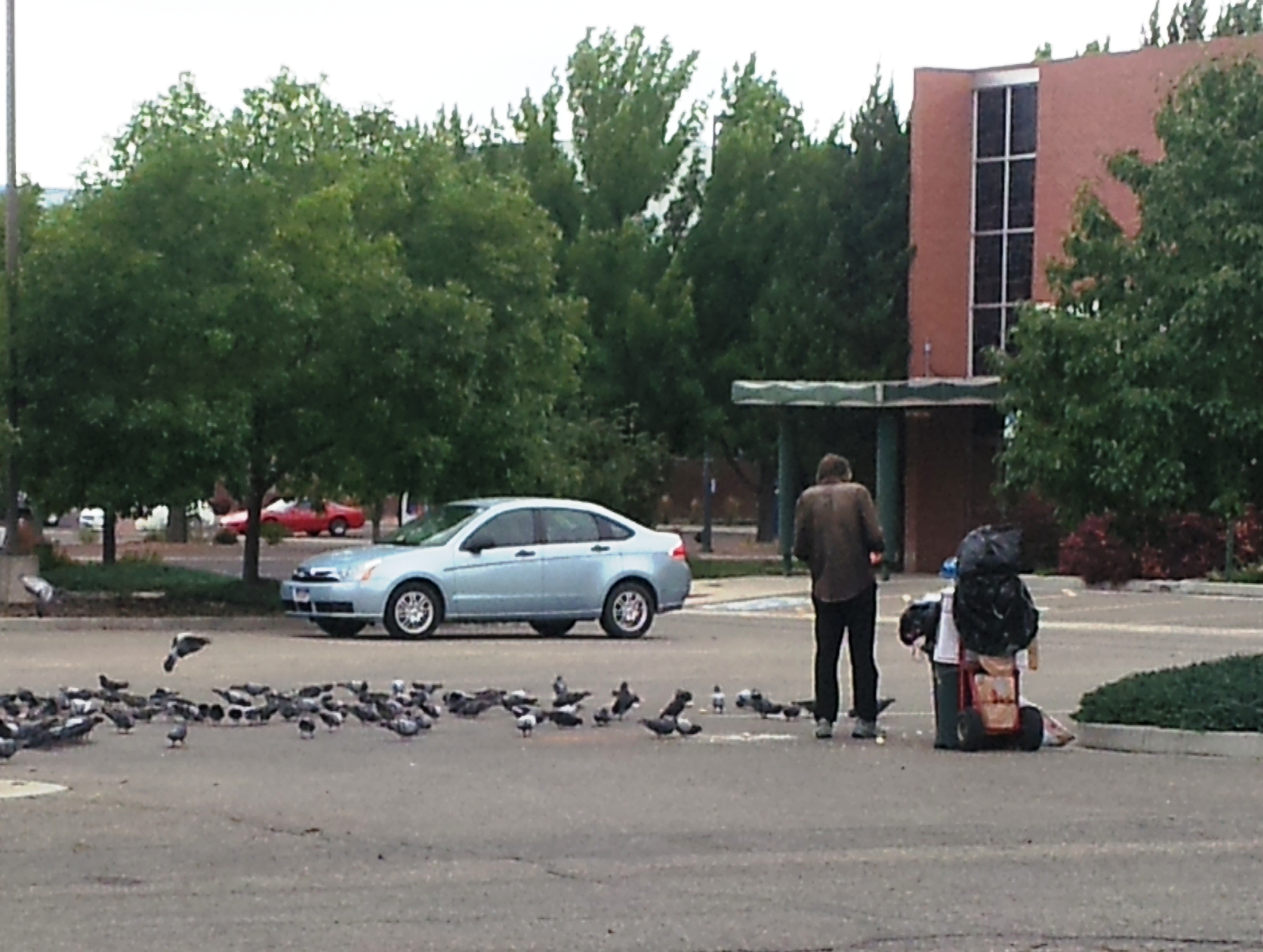
Birdman
Edward "The Birdman" Gillman makes his rounds through Downtown Grand Junction, Colorado, as he has for nearly 30 years.

Between hiking and a short trip to an excellent car museum, we saw a sign of hope and kindness while walking to dinner Downtown. One of the city's most eccentric, resilient citizens, whom I wrote about in 2010, was still actively plying his self-appointed trade.

Ball Fruit
Ball Fruit Stand, Palisade, Colorado

We found kindness in the eyes and smile of the woman at the family-owned bakery a few blocks from the house. The place has been in business for over 65 years, and I'm betting that the decor has hardly changed. The smells coming from inside the place while on a late night walk together was a harbinger of the genuine good will we found there the next day.

We found the same kindness from a Colorado woman welcoming us to her family fruit stand with a ripe peach for each of us. Leslie thought it particularly touching that she referred to us as a married couple - something that is an unfortunate rarity in some circles.

Carousel
 Gage Park Carousel, Topeka, Kansas

More good will came from the staff manning an antique carousel in a city park in Topeka, Kansas. The lady there took the time to speak with us about the carousel and its restored original wooden horses (which Leslie loves), and let me take a closer look at the working Wurlitzer Band Organ. We got to ride two other carousels on the trip - one in Abilene and another at an old amusement park outside of Denver.

We'll probably go back to Abilene for the preserved old west buildings, tourist railroad, and the Eisenhower Library, but also for the pleasant dispositions of the inhabitants. All except for the mosquitoes - they were something else entirely.

Dana Thomas
Dana-Thomas House, Springfield, Illinois - Built 1902

Just before our (literal) sprint home, we spent part of a day exploring some of the treasures of Springfield, Illinois. These included the home and tomb of Abraham Lincoln, and one of the finest examples of the early work of Frank Lloyd Wright.

We were able to see most of these while walking through the Downtown area. It was on the way back to our car, not far from the State Capitol building, that a young woman walking in the opposite direction looked at us and gave us one of the best memories of the entire trip.

She said, "You make a cute couple".

Sunset Russell KS
Near Russell, Kansas.
Have a great week ahead.

Friday, May 03, 2013

Bordering on the Bizarre - The Shopping Center Splits


There are 130 separate municipalities in Allegheny County, dividing up the county's 735 square miles in some unique, and in some cases historic, ways.
Like those boundary lines, some of these communities are anachronisms, struggling to maintain relevance and viability amid economic and cultural upheaval. Others are thriving beyond their ability to manage the amount of people, associated traffic, and service demands that are set upon them. Some of those demands spill over into other jurisdictions, requiring changes to the relationships between existing governments, or perhaps the creation of relationships where none previously existed.
This series is designed to illustrate and educate about some of the more interesting ways these boundary lines affect the lives and decisions of citizens, their leaders, and others who make our towns, counties, and state the place that it is - for better or for worse.
This time, I've found several examples of how shopping plazas, malls, and other similar areas challenge the assumptions we as citizens make about who has responsibility for public safety and other services.
Each illustration below provides a little insight, or links to it, into how a particular area became what it is today, and in some cases how the towns responsible for the area cooperated - or not - in the creation of these areas, and how their existence affects a community's quality of life.
There were more of these areas than I thought there would be, but it's not really surprising. In most cases, the involved towns are benefiting jointly from the revenue that their slice of particular retail pie is generating, which would kind of explain their existence in the first place.
There are also a few jurisdictional quirks unique to the Commonwealth that are near to and/or affect those who may frequent a shopping plaza. I've included some of these as well.
I focused on construction that occurred in the midst of a border line, instead of highways where development crept outward across a municipal, or even county boundary. There are plenty of examples of that (Cranberry, Peters Township, Hopewell) to go around.
Your insights are appreciated, as always. Have a great month ahead.
South Hills Village
The "Grand-daddy" of area shopping malls, South Hills Village has been around since 1965, straddling the border between Bethel Park and Upper St. Clair. That line is a straight one, save for the inexplicable little jog in the middle of the mall. Both communities maintain their own separate public safety dispatch centers.
An extra added jurisdictional bonus is the Blue Line light rail station and adjacent Park and Ride lot and garage. Law enforcement for these areas is the responsibility of the Port Authority's Police Department. Credit: Bing Maps / John Linko


Crafton Ingram
Crafton-Ingram Shopping Center
A lone testament to truth in advertising. The boundary dividing Crafton Borough and Ingram Borough runs right through the middle of the parking lot.  Credit: Bing Maps / John Linko

Wexford Plaza
Wexford Plaza
The shopping center's website describes it as "Wexford's main street for over 3 decades".
Considering that the center is split between two municipalities, and that Wexford is for all practical purposes little more than a mailing address, is it any wonder that there's an identity crisis going on here?
Nevertheless, it's interesting that the border of Pine and McCandless runs right through a little breezeway of sorts, as if the gap between buildings was made for it.
Also, the western boundary of North Park is adjacent to the complex. The Allegheny County Police are responsible for law enforcement there. Credit: Bing Maps / John Linko

McIntyre Square
The site of the former McIntyre Shelter for children, the property was sold by Allegheny County and developed in the early 1990's.
A key consideration for approval by the two townships involved was to assure that traffic could flow through the complex without additional negative impact on McKnight Road, AKA the "McKnightmare". This is probably why the access road through the complex connects McIntyre Road to Peebles Road. Credit: Bing Maps / John Linko

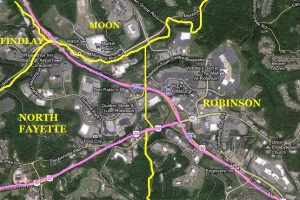
The Mess at Robinson
The Mess at "Robinson"
The massive commercial and industrial development starting at Settlers Ridge (bottom right) and extending to RIDC Park West (top left) is collectively referred to by many as "Robinson".
In reality, the complex spans 4 different municipalities, with public safety resources coordinated by 6 different dispatch centers.
This includes the limited access highway that bisects the complex - more about that in the next photo. Credit: Google Maps / John Linko

The Mess at Robinson 2
Exit 59 and Surrounding Area
Driving around in this area can give you a complex, especially if you need help. Knowing where you are can be a challenge, as the line between Robinson and North Fayette Townships basically divides the interchange, as well as the parking lot of Lowe's, just to the south.
If you happen to be on the Parkway or one of the on or off ramps (highlighted in pink), there's a bonus - law enforcement on limited access highways such as I-376 is the responsibility of the Pennsylvania State Police.  Credit: Google Maps / John Linko

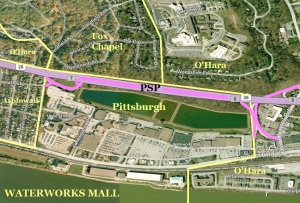
Waterworks
The Waterworks - How Not to Do It
A lot of people think that when they're shopping here that they're in Fox Chapel or O'Hara Township - heck, even the company that built the place thought so.
Surprise - the mall, adjacent UPMC St. Margaret Hospital, and the Pittsburgh Water Plant across Freeport Road is actually a somewhat solitary outpost of the City of Pittsburgh, surrounded by the above communities, as well as Aspinwall. The State Police are responsible for nearby Route 28.
The associated traffic, crime and other impacts, without any say in planning or sharing in any of the tax revenue that the City enjoys, was something that had these neighboring towns bristling a bit when the complex was first opened.
Whether or not the situation has improved is unknown, but one thing appears certain - cooperation and coordination didn't appear to be a priority from the start.  Credit: Bing Maps / John Linko


The Waterfront
The Waterfront - Making the Best of It
In contrast, redeveloping the land that hosted the historic, mammoth Homestead Works could have been a significant challenge for the three towns that hosted the steel plant. But as Wikipedia notes, "The Waterfront was predominantly a private investment, although there was a tax increment financing of approximately $25 million approved by three separate municipalities, one county, and one school district, a notable accomplishment".
While the complex's sprawling size and lack of pedestrian walkways in many places makes getting around it a little tough, there appears to be a commitment by the towns who benefit from it's operation to keep it safe and attractive to residents across the region.
The complex employs private security that interfaces regularly with the three municipal police forces. Additionally, officers from those departments provide dedicated patrol of the entire complex during peak periods - without regard for jurisdictional boundaries.
Munhall still maintains its own dispatch center, but the level of cooperation between them and neighbors Homestead and West Homestead remains good. It's not perfect (what is?), but it's a step in the right direction.  Credit: Bing Maps / John Linko

Friday, April 19, 2013

Familiar Territory...Again

Image

This is the t-shirt that I pulled out of my closet to wear on Monday morning. By mid-afternoon, its significance to me had changed dramatically.

The shirt is at least 10 years old; I bought it from the crew at Ladder 15 / Engine 33 of the Boston Fire Department, while walking past their station at the corner of Boylston and Hereford Streets in the Back Bay section of Boston - about 3 city blocks from where the bombs went off at the finish line of the Boston Marathon. Theirs is one of the busiest fire stations in the country, and the one closest to this latest example of how freedom isn't as free as we would like.

Boston is a familiar and frequent destination - especially the Back Bay. While I've never been there for the Marathon, I've had the opportunity to experience several times the richness, in both literal and figurative terms, that these few square blocks have to offer. I've walked these blocks, from Boston Common past the Public Library to the Prudential Center, over to the Christian Science Headquarters, Symphony Hall, the Berklee and BU campuses, and eventually to Fenway Park.

There are numerous personal and professional benchmarks for me associated with this small area - too numerous to list here.

That many of these institutions and attractions have had their operations significantly altered or halted by the bombings, as well as the manhunt that unfolded today, speaks not only to the density of the area, but its fragility in the face of the commitment to freedom and liberty that it also collectively represents.

One question that will stick out for me is the amount of disruption that occurred today - a major city basically shut down, house-to-house searches carried out - all to track down one man - I'm wondering how much our society will be changed or de-sensitized to this, or how our priorities as citizens are affected. "They searched the basement? Well that's a shame, but they cancelled the Bruins and the Pens!"

The fact that this attack occurred on Patriot's Day - Massachusetts' official commemoration of the first battles of the American Revolution - should serve as a clarion call for resolve to live as those first patriots did - moving forward, without fear.

This is a most volatile week in our nation's history - our resolve to not cower in the face of terror, regardless of is origins should be strengthened by our recognition of our history and a commitment to keep us safe, peaceful, and free in spite of the cowardly and cruel actions of others.

The Back Bay area, like the metropolitan area around it, is a locus of cultural, tourism, business, historical, and shopping activity that ranks right up there with similar, more famous destinations around the country. That it is suddenly the latest addition to a list of battlefield sites in a war as difficult to understand as it is to fight and prepare for is sad and unfortunate.

I'm hopeful that the apparent quick apprehension of the perpetrators will show not only our resolve as a people to live free and without fear, but also that the freedom that Boston represents for all Americans must be respected by those we entrust with the power to protect and to govern.

My thoughts and prayers go out to all those touched by this tragedy.

Sunday, March 31, 2013

Cell Phones and 9-1-1: Image vs. Reality

"From the Desk of the Mayor", Leetsdale Borough Newsletter, March 2013

Easter blessings to you.

I don't often write in this forum about the particulars of my profession. Looking back, it's been about a year since I explored the topic in depth.
Besides, I sometimes get the distinct feeling that most people, including those closest to me, have only a certain level of tolerance for the minutiae inherent in making a complex system function with grace and efficiency in the vast majority of circumstances. So when I'm not working, I try to think and write about other things that matter to me.
However, recent developments have me thinking about the potential consequences of communicating misleading, incomplete, or inaccurate information to citizens about this critical service, and especially how it works when using a cell/wireless/mobile phone.

It's Only a Movie..Only a Movie...
With that in mind, a movie came out earlier this month that incorporates 9-1-1, cell phones, and dispatchers as the the heart of the story. The Call stars Halle Berry as a 9-1-1 Telecommunicator forced to confront a critical, career-changing incident not once, but twice.
Too often I look at this type of entertainment and pick apart the differences between it and real-life circumstances. This tends to annoy those around me. Plus I can't in all fairness say whether or not the movie is any good based on just the snippets and hype.
I watched the trailer a couple of times, and came up with the same general observations that come up when film and TV attempt to enter the 9-1-1 realm:
1. Those 9-1-1 operators that work in open space environments, with high ceilings, abundant natural light, and state-of-the-art, ergonomically friendly equipment, are a decided minority in the business. Progress is being made, however - so much so that I actually know people plying the trade in such lovely surroundings - lots of them. Unfortunately, this does not include me.
2. Too often, entertainment vehicles that feature a dispatch center include the best of technologies - things that may not be available in all areas. This movie does it a little differently - it's plot moves along on the premise that a prepaid cell phone, such as those marketed by companies like Tracfone, Net10 and others, cannot be located via Global Positioning System (GPS) trackingas other mobile phones can. This is not true - many of these phones do give their location when calling 9-1-1.   
Cell Phone Reality #1: While technology can help 9-1-1 professionals locate people in need, it's only one part of the solution. Human beings helping other human beings is still what makes thisworld go 'round.
If you're really interested in learning more about the film from a 9-1-1 perspective, the Editor of 9-1-1 Magazine, probably the most informative publication about the profession, is also a film buff. Hiscolumn about the movie is sure to entertain and inform anyone with more than a passing interest in what public safety folks do day-to-day. 

Leetsdale Mayor's Cautionary Tale Highlights Best Practice Challenges
What really got me thinking about things was this month's Leetsdale Borough newsletter, specifically Mayor Pete Poninsky's contribution, which is pictured above. The Mayor focused specifically on the fact that his town sits on the county line, and as such some cell phone calls to 9-1-1 go to neighboring Beaver County, when Allegheny County dispatches the borough's police and fire departments.
This happens because some of the cell phone towers that provide coverage into Leetsdale are located in Beaver County, and are designed to send calls to the 9-1-1 center where the tower is located.
The Mayor's comments raised my eyebrows a bit when he stated "The call will then be transferred to Allegheny County 9-1-1, which will cause a 5 to 6 minute delay".
They stayed up when he suggested that cell phone users dial a 10-digit number, instead of 9-1-1, to reach Allegheny County directly and potentially avoid this delay.
As someone with more intimate knowledge of how this is supposed to work, I was surprised by this allegation. In general practice, the transfer of a call between one county's 9-1-1 center to another should take no longer than 15 to 30 seconds to accomplish. 
Great strides have been made in recent years to make sure that our area's emergency services function in a well-coordinated fashion, beginning with simple, direct access via our nationalemergency number.
To recommend that citizens dial any number other than 9-1-1 in an emergency, regardless of how well-intentioned the reason, constitutes a step backward in these efforts.
I spoke with Mayor Poninsky, and asked him what information he had to support his general statement about call delays. The Mayor admitted that his statement was based not on an identified pattern or trend, but an isolated incident involving an ambulance call in the borough.
This brings up additional factors involving the reason for any delay, as calls for EMS in Leetsdale must also be transferred to Valley Ambulance Authority for response. The ambulance service maintains it's own dispatch center, instead of relying on the county 9-1-1 center for service.
When trying to analyze how things work (and don't) in complex systems such as public safety, it's helpful to break things down into components common to best practices in many industries. For example:
Technology: There's an obvious need for at least one more cell tower in Allegheny County to cover Leetsdale and surrounding areas. Unfortunately, it's difficult to convince mobile phone companies that new towers are needed - more infrastructure cuts into their revenue and profits, and many communities try to resist towers over aesthetic or health-related concerns. 
Leetsdale Police Chief James Santucci, who also has a background in dispatch center management, estimated that the dividing line between cell coverage from towers located in Allegheny or Beaver County is in the area of Henle Park and Victory Lane. 
He also stated this can vary, however, on the user's cell phone carrier and even what type of network they are using. Someone using Verizon's 4G network, for example, may get coverage from a different tower than if they were on their 3G network. 
Regardless of these variations in cell tower and/or network coverage, you as a citizen deserve to have your call processed promptly and efficiently, regardless of which side of an imaginary line you find yourself on. This involves factors that go beyond the physics of radio, or the cold calculus of electronics. 
Cell Phone Reality #2: The person answering your 9-1-1 call may not be anywhere near your actual location, or as familiar with your area as you might be. Be prepared to answer questions as fully and calmly as you can.  
Processes: Even though some towns and agencies choose to do their own dispatching, most of them tell their residents to call 9-1-1 in an emergency. They know that by doing this it will also trigger the notification of agencies that they do not coordinate, but that may also be needed. 
The 9-1-1 centers in turn must quickly gather the required basic information, identify the need for a transfer, and successfully make that transfer. This happens hundreds of times a day in our area.
Unfortunately, at times the information necessary to determine whether or not the call requires a transfer is unclear, or must be repeated to multiple people. Chief Santucci cited this as a possible contributing factor to the incident that the the Mayor referred to in his newsletter article.
This highlights a process that also involves technology - the ability to quickly share data between dispatch centers could speed things up considerably, but would require a solution to connect what are currently different computer systems. 
People: None of the above can truly succeed without the effort of dedicated, well-trained professionals and the cooperation of an engaged, well-informed citizenry. Unfortunately, it's also a given that the amount of dedication, training, cooperation, and awareness varies greatly.  
Challenges like these extend across all of these areas, especially as technology continues to evolve, processes adjust to adapt, and people change their lives in response..or not.
Cell Phone Reality #3: Your brand new, state-of-the-art smartphone may be eclipsed by the next big thing 6 months from now. 9-1-1, however, has been behind the curve from the start. 
Since cell phones first hit the marketplace in the mid-1980's, those of us in public safety communications have been playing catch-up with the industry to assure that citizens who have an emergency situation can use this technology to get the right help to the right place. 
This has been a tough job, especially when popular features such as text messaging, mobile Internet and VoIP phone services, still and video cameras, and the ability to upload information to social media platforms has become commonplace - all without assuring first that public safety and 9-1-1 are prepared to deal with it. 
The primary government agency that holds sway over the mobile phone industry is the Federal Communications Commission. The FCC makes the rules that require the cell phone companies to provide for location information, as well as to promptly report cell service outages or disruptions.
Cell Phone Reality #4: The FCC also made the rule that requires all working cell phones to be able to call 9-1-1, regardless of whether or not there is a service plan for them. In other words, remove the battery from your old cell phone before giving it to a child to play with. Please and thank you...

The Future Is..Wait a Minute, It's Here Already
If you have a modern cell phone, you hold a marvel in your hands. The technology that makes your phone work is revolutionizing telephone systems from the ground up. The foundational world of mechanical, then electronic switching that made our landline telephone network possible is gradually giving way to the Internet as a new foundation - and 9-1-1 is following suit as best it can. 
Next Generation 9-1-1 offers the promise of establishing reliable communications networks that can handle all of the different ways that critical information can be sent today. It also changes the way that 9-1-1 services can be accessed and delivered, allowing for greater efficiency and the potential for reducing long-term operating costs.
The state agency that oversees the provision of 9-1-1 service in Pennsylvania is the Pa. Emergency Management Agency. PEMA appears to have a handle on the needs, benefits, and challenges behind making the transition to this next level of technology, in order to positively address citizens' expectations of both effective service delivery and that government revenue be spent in an efficient, responsible manner. 
This involves processes and people as well. The removal of physical limits related to legacy phone networks creates the potential for consolidation of both dispatch centers and the vendors that provide them with technology and maintenance support. A recent illustration of these potential trends from another industry is the announcement this past week of the rumored phasing out of the US Airways operations center in Moon Township.
Another example of how much things may be changing came to light this month as well, as the FCC posted a notice that they will be looking into the possibility of changing that rule about all working cell phones being able to call 9-1-1.
This is in response to the volumes of accidental calls from those phones that aren't connected to a service provider - we affectionately call these butt dials, pocket dials, purse dials, toddler dials, etc. These tie up both available lines and the personnel responsible for promptly answering them. 

There is no shortage of good public information out there about calling 9-1-1. April is National 9-1-1 Education Month - it also marks National Public Safety Telecomunicator Week.
There are plenty of online resources available for free download by citizens, government officials, and educators to help make sure that, even in the midst of unique local operational practices, a simple, direct, and easy to understand message is being sent. 

Change is a Constant
Regardless of the direction all of this goes, dynamic changes like these will continue to impact the way we live. That may sound awfully simplistic, but I don't know of any clearer way to say it.
This also applies to things that we take for granted even more, and perhaps understand even less about what it takes to deliver them to us. Stay tuned... 
Cell Phone Reality #5: We're doing the best we know how. Your cooperation is essential to our success on your behalf.

Monday, December 24, 2012

Square Pegs, Sadness, and Old Rock Stars

A voice is heard in Ramah,
weeping and great mourning,
Rachel weeping for her children
and refusing to be comforted,
because they are no more. 

                             - Matthew 2:18


I would like to be writing about something else as Christmas approaches. It should be a time of joy and quiet reflection, surrounded by those who love and care about you. Despite this, there are other things going on that are making this year's holidays more challenging. 

The Newtown, Connecticut mass shootings have been at the forefront of the national conscience for the last week. This event, even more than others of recent note, has shown the need for all us to step back, breathe deeply, try to make sense of the news flashes and rumor-mongering, and resist the urge to make snap judgments. 

I wrote at length earlier this year after the shootings in Aurora, Colorado. My feelings about the nature of these events remain unchanged. There are some things that spring to mind about this latest event that have to be said, however.

Newtown is to me but a momentary blip on a well-traversed road. Sandy Hook Elementary is but a mile or two from Interstate 84, part of a seemingly bucolic suburban/rural countryside between the New York state line and Hartford, scarcely noted and just as quickly forgotten while trying to get somewhere else. 

Perhaps one of the greatest lessons of Newtown - once and for all - is that it can happen here.

Several articles compared the Newtown shooting with the the biblical account of the Slaughter of the Innocents - in the time after the birth of the Christ child, King Herod ordering the death of all boys under 2 years of age, in hopes of catching the infant Jesus among the dead. 

This was not the first thing on my mind when contemplating these events. My thoughts were thrown back to two evenings before, when I tuned in the Concert for Hurricane Sandy Relief that was broadcast on seemingly every cable network. We were confronted with Roger Waters of Pink Floyd singing what is probably the toughest song of his masterpiece The Wall, with the assistance of Eddie Vedder of Pearl Jam.

Mr. Vedder's presence caused me to start interlacing the lyrics he was singing with one of his own band's more famous songs, topical to the events at hand - 

I have become comfortably numb...

Jeremy spoke in class today....

These were combining in my head with the lyric and haunting solo piano of an Elton John masterpiece from 1974. As a result, the soundtrack of my life this week has been in a decidedly minor key.

You've lived too long in silence, Mama said, remember Mama said, ticking, ticking..

Assuming that life can be compared to a movie, the quality of the script hopefully trumps the background music. Resolve on the part of the players to not allow these events to define us as a society, to rise above them, and join together with the President in saying "enough" - is but the tip of an iceberg of issues that seem to combine to create the atmosphere where such atrocities can occur. 

To be sure, we've had enough - but enough of what?

Guns - I believe that gun laws would likely not have prevented what happened in Newtown - the guns used were legally owned by a law-abiding citizen. Regardless of what the NRA had to say (and was there really any doubt about what they were going to say?), we as a country need to take a good hard look at both the practical and cultural aspects of guns in our society. 

There are legitimate arguments on both sides of the debate about whether or not to ban the sale of semi-automatic assault weapons. Efforts to close the so-called "gun show loophole" equate to the prohibition of gun sales between private individuals, which would effectively require a background check for any gun sale conducted within the boundaries of the law.

The NRA's initial suggestion of an armed presence in every school - something they're calling National School Shield - sounds more at the onset like a reactive posture that only addresses one component of what needs to be a comprehensive solution. As such, it landed in Connecticut with a decisive thud.

A best practice methodology - one that addresses technology, processes and people and leverages resources on a multi-disciplinary basis - is for me the best approach toward applying a solution that is both responsive in the short term and sustainable over the long haul. Those other disciplines are:

Mental Health - Newtown is yet another example this year of deadly actions taken by a subject - in this case 20 year old Adam Lanza - who had displayed very high intelligence accompanied by social isolation, combined with the means, financial or otherwise, to accomplish his ends. 

This is bringing additional public debate about the nature of the safety net that is supposed to be in place, in the form of community mental health services and crisis team response.

There are several excellent posts on a Washington Post blog that delve into many issues surrounding the mentally ill in America - from the lack of effective treatment options to the lack of understanding of certain disorders such as Asperger's Syndrome to the demonization and stigma surrounding those who are suffering.  

One writer took the novel approach of suggesting that the firearms industry should take an active role in funding mental health outreach programs. This made me think of Chris Rock's idea on how to reduce gun violence. 

Still another blogger saw a post written about her personal experiences as a parent of such a child, titled "I am Adam Lanza's Mother", go viral. She wrote an excellent follow-up in USA Today. This all sounds like a bizzaro version of an Erma Bombeck column.

I believe that there are many people, including myself, who share personality characteristics similar to the shooters at Western Psych, Aurora, and Newtown. I believe that the effects of social isolation, along with environmental factors and stimuli unique to our period in history, are contributing factors to a documented increase in children being diagnosed with what are known as Persuasive Developmental Disorders.  

Now imagine, if you can, being unable to effectively interact with anyone unfamiliar, instead retreating into an artificial environment of television, computers, and/or video games. Something happens, that world is threatened, and you cannot cope. Your attempts to secure help are met with misunderstanding, dismissal, or contempt. You drive yourself deeper into escapes from this reality, until circumstance backs you into a corner. A response from outside the acceptable boundaries of reality appears inevitable.

This was expanded upon by an anonymous writer, who submitted an essay to Newsweek/Daily Beast, which published it under the provocative headline I Was Adam Lanza. Now a more stable adult after years of therapy, the writer attempts to explain, from first person experience, how someone like Mr. Lanza may have been driven to his actions. This stuck out for me -

When your brain works more efficiently than everyone else's, that means it performs most mental tasks more efficiently than other people, including go crazy. Worse, because a smart person's brain is so good at running through hypotheses and rejecting them, it tends to come up with insanity that's more resistant to basic therapy, because the rationalizations are built to withstand the assault of a genius level intellect. When people say genius and insanity are close cousins, this is what they're talking about.

And when you're isolated from other people, your own mind - and its crazy ideas - becomes the only company you have.

I have no scientific basis for any of this, of course - just a feeling based on my own life - that there is a comfort in the speed and ease (mostly) of electronically produced results, and the illusion of control when dealing with the cool, arbitrary nature of ones and zeroes. It doesn't translate well when facing tragedies and choices in the real world. Paging Neo and Morpheus...

School Safety - Before we establish an independent, separate layer of armed security at the behest of a lobbying group that serves firearms manufacturers, let's look at what's in place so far, and how we as a community can enhance those efforts.

My experience with school safety and response planning, mostly in Colorado, centers on extensive use of the School Resource Officer (SRO) concept. According to a tutorial from the Center for Technology in Education at Johns Hopkins University, an SRO is best defined as - 

..a sworn law enforcement officer, assigned to a school on a long-term basis. The SRO is specifically trained in and performs three main functions, law enforcement officer; law related counselor; and law related educator. In addition the SRO works in collaboration with the school and the community as a resource.

That aptly describes the SRO's I worked with out west - not just an armed guard standing next to a metal detector, but someone who was invested in providing an active, responsive police presence not only to their assigned schools, but to the general community surrounding them. A component of the community public safety system, there to educate as much as to protect and serve.

This concept appears not to be as well embraced in Pennsylvania as it could be. A comprehensive article, published in 2000 by the National Center for Juvenile Justice - now headquartered in Pittsburgh - detailed what was then a grant-funded program to place SRO's in several schools across the commonwealth.

The article detailed the daily activities of North Fayette Township Police Officer John Bates, the SRO at West Allegheny High School, and the pilot SRO program initially funded by grants from the Pa. Commission on Crime and Delinquency.

The SRO program there is still in place and functioning well, according to now Sergeant Bates, who when contacted last week stated he was getting a lot of calls from nearby school districts about their program, which is now jointly funded by the township and the school district. 

As reported extensively in recent days, Quaker Valley schools employ an armed police officer as an SRO. Robert Wright appears to function as a district employee when on duty, even though he also works as a police officer in Sewickley. Whether Officer Wright can exercise police powers when he's wearing his QV hat is unclear, and is something I will explore further after those in charge return from their holiday breaks.

The National Association of School Resource Officers (NASRO), responding to the NRA's recent comments, stated that "only a fully-trained law enforcement officer should carry a firearm on school property. In addition, law enforcement officers assigned permanently to schools should receive specialized SRO training as soon as possible."

It sounds as if Quaker Valley is ahead of the curve on this issue, but I think that there's room for improvement in terms of providing a layer of protection, service, and response that is seamless between school and community. This means that the officer protecting the high school can also help to investigate and mitigate problems in the neighborhoods surrounding the school. Things like traffic and parking issues.... 

As much as I would like to talk about moving forward in the spirit of peace and love, the reports of continued violence continue to stream in. While I wrote this today, public safety brethren in the Rochester, New York were reeling from today's fire and ambush that killed 2 volunteer firefighters. One was also a police officer, the other a 9-1-1 Dispatcher.

Hope is a precarious emotional commodity, even at this time of the year. I remain faithful that we'll see our way through this. Hearts and minds are stirring - it will be messy, but we will get through it - together.  

We need to watch out for, and care for, one another. That collective action of our hearts and minds is greater than any gun, badge, doctor, or government agency, and is keeping with the true spirit of this season. 

The luminaria will probably be wet tonight, but they will still be lit.

I'll wish you the best possible holiday with a couple of 70's throwbacks, both involving old rock stars and some unlikely combinations of music and performers.

Here's to a blessed and peaceful Christmas, courtesy of Sonny and Cher and David Bowie and Bing Crosby.

And to all a good night.