Showing posts with label Local. Show all posts

Tuesday, August 20, 2013

Travelogue, et cetera - Of Apples and Oranges, Peaches, Donuts, Caves, and Kindness

To this place, and the kindness of these people, I owe everything.

- Abraham Lincoln, Farewell Address at Springfield, Illinois - February 11, 1861

It's been a varied and busy last month or so. This has been more interesting than usual because of all the places we've been over that time frame.

We had the 9-year-old son of Leslie's best friend with us for a week in July. We went bicycling in North Park and swimming at the Sewickley Community Center - activities that were simple, low cost, and a lot of fun.

Penns Cave Hotel
The old hotel at Penn's Cave, Centre Hall, Pa.

We then took Aaron home to New York, and on the way experienced Penn's Cave in rural Centre County. Aside from the cave itself, which is intensely interesting, the wildlife park, original 19th century hotel, and meticulously maintained grounds were also impressive. The money and time for this visit were well spent.

On the way back, Leslie and I enjoyed breakfast at a favorite diner, and then spent some time at an outlet mall in Tannersville, Pa., which is about 10 miles from Ross Township in Monroe County. This was the scene of a shooting at a municipal meeting on August 5 that left three dead and several wounded. This included the shooter, who sought revenge for losing his property to condemnation, the culmination of a local dispute that reportedly lasted over 20 years.

This incident generated some discussion locally about security at municipal buildings, including here in Leetsdale. Borough council seemed concerned primarily with day-to-day access to borough offices, which while a valid concern didn't seem to me to pose the greatest overall threat.

LeetsdaleBoroBldg Exterior
Leetsdale Borough Building - Council Chambers as seen from Beaver Street. Credit - Google Maps

As the attached photos illustrate, the entire council chamber is both proximal and visible to anyone walking or driving by on Beaver Street. I'm wondering how something like that would be viewed by someone doing a professional threat assessment, and what their recommendations might be. Consider that the Monroe County suspect began his rampage by shooting through the walls.

Interior of Leetsdale Council Chambers. Council and other officials sit facing the exterior windows.
 
Credit - Sewickley Patch

Prior to this, Leetsdale also made news for proceeding to advertise for the hiring of a Borough Manager, which on the surface runs counter to what the majority of council seemed to advocate when they were elected in 2011, and also when they summarily eliminated the position upon taking office in January 2012.

I congratulate Leetsdale Council for apparently recognizing the need for day-to-day, professional municipal management, and acting in a responsible way to fill the position. I say 'responsible' because they are engaging independent, professional assistance to conduct the recruitment.

At the end of July we were once again on the road, this time back to Colorado for the first time in over 2 years. While we spent a good amount of time there visiting with my son, the trip wasn't long enough, especially in relationship to other things we did along the way. While they didn't take an extraordinary amount of time (and yet were very worthwhile), they did eat into our travel goals to the point that it took a good couple of days to recover after we got back - between work shifts, that is.

Both before our departure and after our return, the topic of property tax reassessment appeared in the news again. First, the Tribune-Review reported on July 30 that Allegheny County was returning to a base-year system of doing tax assessments, perhaps headed down the same road that got them sued several years ago. Then this past Wednesday, the Trib reported on Washington County's plans to abide by a court order to re-assess...after 32 years.

The first Trib story pointed out a glaring observation about the archaic nature of taxation and governance in Pennsylvania - “There's no state law that requires periodic reassessments. Pennsylvania is one of a handful in the country that don't.”

I resist making comparisons between Pennsylvania and Colorado - the differences in governance are too stark - but apples to oranges or not, it's gotta be said:

Colorado counties re-assess all property every odd-numbered year, as required by state law. Over the 10-plus years that I have owned property there, I've seen my assessed valuation, and along with it my taxes, fluctuate with the condition of the market and the economy over that time frame.

With the near-collapse of the housing market in 2008 came a significant reduction in the market value of the property, and a corresponding reduction in the tax rate after the 2009 reassessment. Essential government services were maintained, but a lot of the fat was cut out of municipal budgets, some layoffs occurred, and some necessary hiring and procurement was pushed back.

Government expanded and contracted with the times and the economy - what a concept. Admittedly though, a good many governments in Colorado don't have unionized employees. More evidence of the need for effective day-to-day management of municipal operations, including budgets and financial planning, in response to these factors.

This doesn't mean that a full-time manager is a guarantee that all will go smoothly. The Leetsdale manager will likely serve at the pleasure of the governing board of elected officials, as most other appointed municipal managers do.

When some of those elected officials engage in potentially questionable activities on their own, it may hinder the ability of a manager or administrator to do their job effectively. This was most recently illustrated by media reports of private meetings by the Cecil Township Supervisors with Range Resources, and by Moon Township Supervisors with Robert Morris University.

So we'll see how things pan out in Leetsdale. I'm cautiously optimistic.

Colorado and Pennsylvania do share a lot of common ground - big energy continues to loom as a threat to rural ways of life, including water, traffic, and development issues. My former next door neighbor, an energy worker and part-time writer, recently chronicled some of the more subtle, but no less significant, impacts of fracking on the human condition. His column made its way into the New York Times.
Birdman
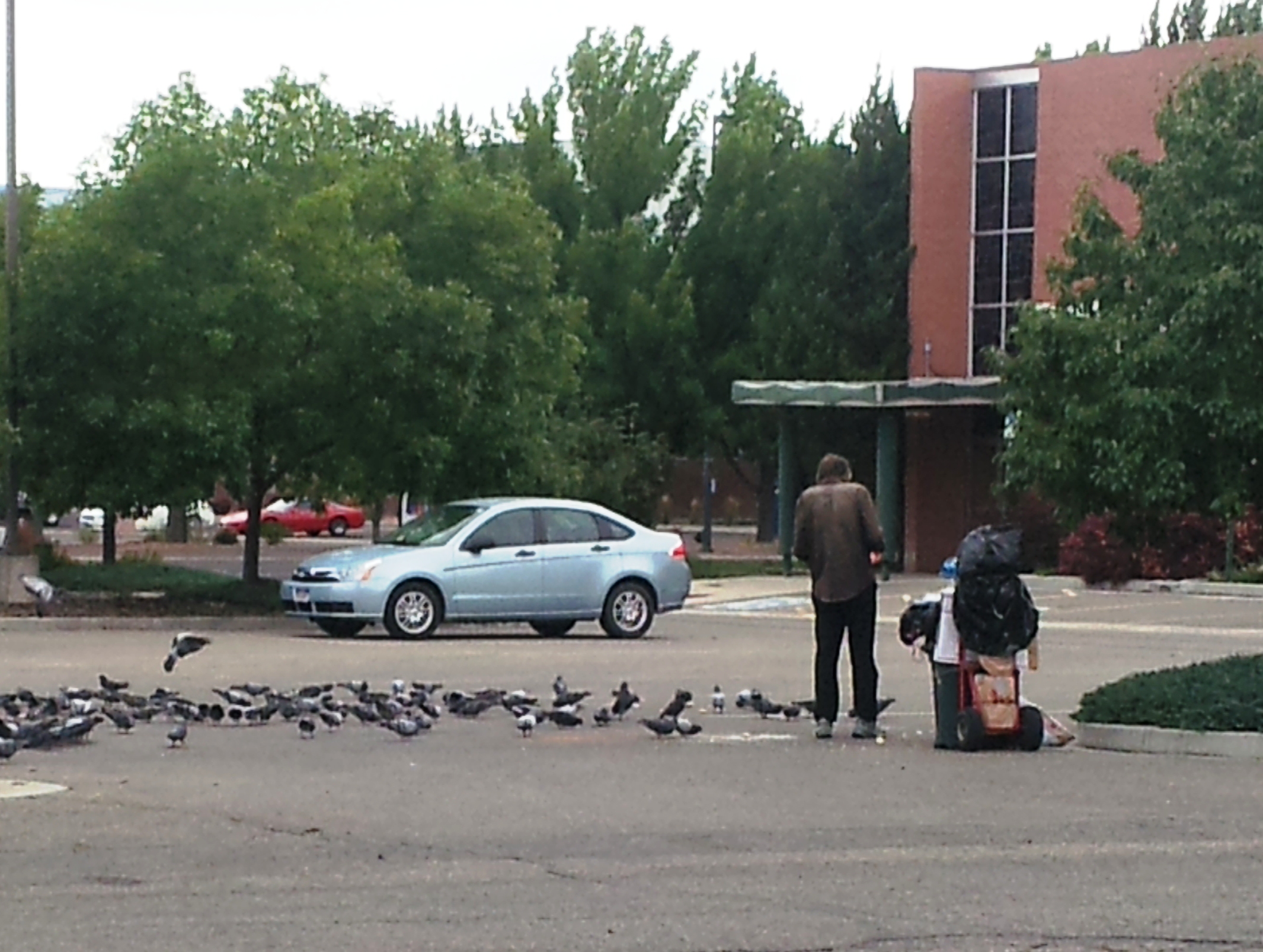
Edward "The Birdman" Gillman makes his rounds through Downtown Grand Junction, Colorado, as he has for nearly 30 years.

Between hiking and a short trip to an excellent car museum, we saw a sign of hope and kindness while walking to dinner Downtown. One of the city's most eccentric, resilient citizens, whom I wrote about in 2010, was still actively plying his self-appointed trade.

Ball Fruit
Ball Fruit Stand, Palisade, Colorado

We found kindness in the eyes and smile of the woman at the family-owned bakery a few blocks from the house. The place has been in business for over 65 years, and I'm betting that the decor has hardly changed. The smells coming from inside the place while on a late night walk together was a harbinger of the genuine good will we found there the next day.

We found the same kindness from a Colorado woman welcoming us to her family fruit stand with a ripe peach for each of us. Leslie thought it particularly touching that she referred to us as a married couple - something that is an unfortunate rarity in some circles.

Carousel
 Gage Park Carousel, Topeka, Kansas

More good will came from the staff manning an antique carousel in a city park in Topeka, Kansas. The lady there took the time to speak with us about the carousel and its restored original wooden horses (which Leslie loves), and let me take a closer look at the working Wurlitzer Band Organ. We got to ride two other carousels on the trip - one in Abilene and another at an old amusement park outside of Denver.

We'll probably go back to Abilene for the preserved old west buildings, tourist railroad, and the Eisenhower Library, but also for the pleasant dispositions of the inhabitants. All except for the mosquitoes - they were something else entirely.

Dana Thomas
Dana-Thomas House, Springfield, Illinois - Built 1902

Just before our (literal) sprint home, we spent part of a day exploring some of the treasures of Springfield, Illinois. These included the home and tomb of Abraham Lincoln, and one of the finest examples of the early work of Frank Lloyd Wright.

We were able to see most of these while walking through the Downtown area. It was on the way back to our car, not far from the State Capitol building, that a young woman walking in the opposite direction looked at us and gave us one of the best memories of the entire trip.

She said, "You make a cute couple".

Sunset Russell KS
Near Russell, Kansas.
Have a great week ahead.

Monday, July 22, 2013

Critical Mass on University Boulevard


Univ Blvd 3
University Boulevard in Moon Township, looking south from the entrance to the Robert Morris University-owned Holiday Inn. Note the absence of a center turn lane and sidewalks, as well as the utility lines in close proximity to the roadway.                        Credit: Google Maps
In the course of growing up and working in the northwest suburbs of Pittsburgh, I learned to develop a love/hate relationship with a stretch of road in Moon Township now known as University Boulevard.

It's been known by that name since 2003, when the Moon Supervisors changed the name, in part, to "promote one of (Moon's) many assets and one of its largest employers, Robert Morris University", according to a Beaver County Times story.

Prior to that, the road went by two names - Narrows Run Road from Thorn Run Road up to the intersection with Brodhead Road, where it became Beers School Road to the end at what is now Business I-376.

Aside from any humor associated with Robert Morris changing from a "beer school" to a "university", the name change does make sense, even if the road itself largely fails to live up to its namesake. 10 years after the fact, there is still no dedicated left turn lane to access RMU's main entrance if coming from the east. This will be a recurring theme down the page.

We All Live in the (old) Yellow Submarine...

As RMU has grown, it has naturally sought more student housing. In late 2011 it acquired the struggling Holiday Inn Airport, where it houses some students and stated at the time of the purchase their eventual intent to turn the facility into a dorm in toto. Those of you who spent your formative adult years in this area may remember the hotel fondly for the Yellow Submarine nightclub in the basement.

RMU's stated 3-year plan to convert the building to a dorm is apparently being accelerated, with the announcement this past week that the hotel will close in preparation for full dormitory operations in August.

They need a zoning variance from Moon Township to accomplish this, and not everyone is pleased, for "varying" reasons. Moon Supervisors were quoted in the media expressing significant concerns over traffic flow on University - specifically with the current amount of cars traveling this state-maintained roadway, and the potential for more with the development of a new Walmart store at the site of the former West Hills Shopping Center. They also don't like the prospect of the property being largely taken off the tax rolls.

Township officials also cited the lack of pedestrian walkways, and the already established difficulty in turning left out of the facility onto University to head toward campus - one factor that an RMU Vice President dismissed by asserting that "students living at the Holiday Inn would not be driving to campus".

It made me wonder how exactly the school would go about accomplishing that - denying campus parking permits to residents of the proposed "Yorktown Hall"? Regardless, a shuttle service still has to make that left turn, and enterprising college students can indeed opt to walk or ride bicycles - just like their younger counterparts at Moon Area High School, right across the street.

That's right - the school complex, which includes Moon's stadium and athletic fields, also sits along this stretch of University, along with several other hotels and commercial establishments that sprung up from the 1960's through the 1980's, when the old Airport was located just a fraction of a mile away. This corridor abuts residential areas to the east as well.

Wait Just a Minute, Bobby U...

The Moon Supervisors held a public hearing on July 1, which they continued to this evening after taking testimony and conducting a lengthy executive session, which caused the meeting to extend past midnight.

Based on these media reports, it seems that RMU's timetable for closing the hotel, laying off 60 people, and readying the building for conversion into a dormitory in time for move-in day did not anticipate these regulatory difficulties. Eyewitness accounts from the meeting seemed to indicate that RMU representatives were surprised by the community push-back.

It sounds as if both the issues and stakeholder concerns are sufficiently complex as to warrant a closer look at...well, everything.

I am inclined to agree - The media reports seemed to indicate that discussions about traffic improvements only focused on sidewalks. While I'm not anything approaching a traffic engineer, I don't think it takes that background to see that it's a mess up there on many fronts, with the potential to only get worse with additional development and traffic loading.
Univ Blvd Master
University Boulevard seen south of Moon Clinton Road, with businesses and other facilities labeled.   Credit: Google Maps / John Linko
Things Can Only Get Better...uh, right?

As illustrated above, there are numerous commercial entrances and exits along the stretch of University south of Moon Clinton Road. Many of these entrances are not coordinated, and many parking lots are isolated from one another. The roadway itself is inadequate - it lacks a center turn lane, which would facilitate turn-offs into these local businesses, as well as provide for a smooth transition into left turn lanes at signaled intersections - like the one at the main RMU campus entrance.

Speaking of signaled intersections, there is half of one at Tiger Trail (the entrance to the school complex) that could be expanded into a 4-way intersection, to provide egress from the collective parking areas of the Holiday Inn, Doubletree Hotel, and Hampton Inn. The existing entry/exit points could be converted into entrances only, with the new intersection providing an additional entrance and a safe, signaled exit for the proposed dormitory and adjacent hotels. I've tried to rough this out in the illustration below.

Univ Blvd 2
Close-up of area at intersection of University and Tiger Trail, with illustration of how traffic could flow through the dormitory and hotels to a new 4-way intersection.            Credit: Google Maps / John Linko
New Kid on the Block

Among the numerous other things that would have to happen to make this feasible are connecting the proposed dormitory's parking areas to those of the Doubletree, and securing easements for the property between the two buildings, which is the former location of Betlyn Heating.

This is the property marked as DACOH /Covelli, which currently hosts a seemingly unoccupied house and outbuilding that likely pre-dates the surrounding development, along with numerous mature trees and a large grassy area in front of the Doubletree.

DACOH Holdings LLC is the new owner as of this past April, according to Allegheny County property records. DACOH is the real estate holdings arm of Covelli Enterprises, a Warren, Ohio-based company which describes itself as the "largest franchisee of Panera and O'Charley's" restaurants.

Does this mean that a Panera Bread or other establishment could be coming to this corridor in the near future as well? What does that portend for the traffic situation?

Moon Township Manager Jeanne Creese, contacted last week, stated that the township has received no development application from the new owners, and had no other information beyond knowing that the property was sold. Messages left for DACOH's Pennsylvania representative were not returned.

Fail to Plan...Plan to Fail

Ms. Creese also stated that PennDOT requires a traffic impact study from those desiring to make development changes that may affect roadway capacity. PennDOT District 11 spokesman Steve Cowan, responding to an e-mail inquiry, stated that a traffic study for the intersection at Business 376 was completed in 2009, and that "We are not aware of any other planned activities on University".

That study was executed for Moon Township's Transportation Authority, described on the Township website as "established in 1987 to promote economic and infrastructure development in Moon Township".

This authority was also in the news recently, as the Moon Area School Board voted July 15 to end its relationship with the authority, a move that find its resolution only in the courts. This appears to be a very shortsighted action on the part of the school district, given what seems to be an obvious need for cooperation to manage traffic literally at the doorstep of the district's core facilities.

Hopping Away 

When thinking about what happens when too many things are going on in one general area at the same time, the term critical mass pops into my head. There are several definitions for this, depending on the context in which it is being used. In physics, it defines "the smallest amount of fissile material needed for a sustained nuclear chain reaction". 

That's what this gradual ramping up of activity along University Boulevard feels like to me, along with the feeling that this traffic corridor is a pot full of water on a stove, and we commuters, consumers, students, and full-time residents are all frogs in that pot.
What happens when the heat starts to get turned up?

Without any improvements in traffic flow management, along with reasonable development controls and other coordination efforts, what will an autumn Saturday look like in the future, when it's quite possible that typical Saturday traffic in and out of Walmart and Giant Eagle will be complicated by a youth basketball tournament at Moon High School and an RMU home football game - all at the same time?

I know one thing - there will be a new Walmart in Economy Borough before there is one in Moon, and it will likely be a lot easier for me to get to.

Hope in Collaboration

There is, however, another definition of critical mass - one from the area of social dynamics: "A sufficient number of adopters of an innovation in a social system so that the rate of adoption becomes self-sustaining and creates further growth". This concept is illustrated, albeit simplistically, by the following:


I'm no theoretical mathematician or economist, but I can see the value of this thinking when it comes to reinventing University Boulevard. I'm wondering if some of the traditional attitudes that may stand in the way of making something unique happen represent the 'blonde' in the film clip - attitudes such as non-cooperation, profiteering, and NIMBY.

This extends not only to those engaged in private enterprise, but also to those governmental entities with a significant operational and financial stake that are saddled with the perception - and/or reality - that they are obstructionist and/or combative.

Included as well is a large, privately held, not-for-profit institution that attempts to frame itself as a benevolent community asset, when the reality leans further toward an enterprise engaged in aggressive growth for the fulfillment of its mission, that is used to getting its way.
That these institutions are both in the business of education brings to bear even further the need for innovative solutions, before the wrong kind of critical mass becomes a reality.

The level of cooperation required, and the multiple of layers of stakeholders involved - Local government, PennDOT, multiple above and below-ground utilities, private property owners - is potentially daunting if substantial yet necessary changes to this multi-purpose corridor are to occur.

But think of the advantages to all if everyone will work not only for themselves, but also for the group.

Best wishes to all stakeholders as the process continues to unfold and evolve.

Friday, June 21, 2013

Spurious Signal Propagation

So much has been going on lately that I started alliterating subheadings in my head to try to keep them straight, and try to organize my thoughts about them.

While pondering them in recent days, they seemed to resemble too much unwanted feedback on a landscape of information and occurrences. I tried to have a serious discussion with my wife about religion - and wound up with a headache instead of anything meaningful. That doesn't usually happen.

All of this reminded me of what in radio terms is called spurious signals, or "undesired signal energy present at any frequency at the output of a device that was not present at the input". It's all the noise that gets in the way of what really needs to come through. More about this later.

Here is a sampling of some of that intentionally organized, yet unwelcome random stuff that stands in the way of real progress in my own personal growth - perhaps more of a picture of how my brain works (or doesn't) than one might like.

Brought to you by two letters of the English alphabet.


Surveillance, Secrecy, Snowden - Past is Present 

Has anyone else noticed that this entire episode started out eerily like the first several minutes of The Bourne Ultimatum, right down to the same media outlet breaking the story?
Hopefully it doesn't follow the plot line completely, even though I'm sure that the reporter Glenn Greenwald and his staff are taking whatever precautions they feel are necessary. The same can be said for their source.

Despite all of the additional revelations and events that have transpired over the last two weeks, I will stick with my first impressions about Edward Snowden after reading the interview that the Guardian conducted with him in Hong Kong, and released two Sundays ago - 

"I carefully evaluated every single document I disclosed to ensure that each was legitimately in the public interest," he said. "There are all sorts of documents that would have made a big impact that I didn't turn over, because harming people isn't my goal. Transparency is."

Courageous, misguided, naïve, unafraid, narcissistic - these and so many other adjectives have been used to describe the man. I personally think that he did a service to the cause of personal privacy and controls over what the government can find out, and what they can do with it.

I was listening to Mike Pintek talk about this on KDKA last week. He referred to the Pentagon Papers controversy, which this affair is being compared to, as "ancient history".
Please, Mike - we were both alive when it happened, and just because it happened 40 or so years ago does not make it any less relevant. 

Daniel Ellsberg is also still alive, and commented rather astutely in the Guardian on Snowden's actions:

"Snowden did what he did because he recognised the NSA's surveillance programs for what they are: dangerous, unconstitutional activity. This wholesale invasion of Americans' and foreign citizens' privacy does not contribute to our security; it puts in danger the very liberties we're trying to protect."

Ellsberg also makes a comparison of the NSA's activities to that of the East German Stasi during the heyday of the former Soviet bloc. The 2006 Oscar-winning film The Lives of Others is an excellent dramatic rendering of what it might have been like to live in a society where the fear of someone listening actually affects the nature of the discourse, regardless of the innocence of that discourse.

That is perhaps the best point I have heard in response to all of the reporting, hype, and outcry - that people will "self-regulate" themselves into what they think is palatable to what the government will tolerate.

This is an affront to the liberty of thought that no free society, that wishes to remain so, can tolerate for very long. The fact that all of this started to become public knowledge on the 49th anniversary of the publication of Orwell's 1984 has apparently not been lost on a lot of people.

The government may choose to throw the book at Edward Snowden, or do nothing at all - let him live out his days with one eye continuously looking over his shoulder. There is, however, enough of an outcry on both sides of the political spectrum - including ACLU litigation and a very popular White House petition demanding Snowden be pardoned - that some action to curtail the NSA's activities will likely have to be considered.

We The People, at least those of us who care deeply about the free expression of ideas and dissenting opinion, will not stand for it. Apparently, many citizens are planning to take to the streets this 4th of July in support of the Fourth Amendment. How appropriate is that?


Sewickley Sewer Street Shutdown Surprise - Prolonged

Over the several months, an ongoing project to connect portions of Aleppo Township and Glen Osborne to Sewickley's sewer system has resulted in several street closures and other traffic-related issues - many not communicated in a way motorists and citizens would probably appreciate or expect.

This trend apparently continued with the closing of Beaver Street in the heart of the Village two weeks ago. The Herald's story, dated Tuesday June 4, announced the closure and detour of Beaver at Logan Street to last two days.

The Quaker Valley School District sent a mass e-mail the previous evening, attempting to quickly notify parents of the closure. Communications Director Tina Vojtko made it a point to write that "we were just informed late this afternoon" of the impending detour - I imagined I could almost hear the banging of annoyed fingers on Ms. Vojtko's keyboard as it was being written.

I can't tell you if I was surprised or not to go to church two Sundays ago and see the closure - and associated heavy equipment - still in place. It was later reported that the "2 day" closure ended a little over a week after it commenced.

From last year's closure of Beaver Road in Glen Osborne, to the recent single-lane restrictions on Route 65 in the same community, up to and including this last closure, whomever is responsible at Sewickley Borough needs to make a better effort at communicating restrictions on traffic flow and other services, especially if those delays take longer than expected.

On my regular commute down Route 65 this week, I took note of the backhoe, fresh trenches, and pipe staged below where the road passes behind Osborne Elementary School. Hopefully something will be said about it..well in advance..if they intend to disrupt traffic again.


Sewickley Photoplay Philanthropy Shortage

The Village Theater Company is approaching a self-imposed deadline to obtain total pledges of $1.5 Million to construct a new movie house in the heart of Sewickley Village.

They've got a way to go to reach that goal by the end of the month. This past week I sent them an example of how a community comes together to make a great space possible - something that transcends the space itself.

Village Theater Company needs the community's help, at a fundamental level, to make this happen. It starts with financial resources, at this point in any amount. Best wishes to them in their efforts.


Penguins Paradoxically Plummet - Still Supportive

After following the Penguins during their successful campaign through a lockout-shortened regular season, and then over the first two rounds of playoffs that were rocky but eventually successful, it was distressing to see them basically not show up at all the first two games against the Bruins.

Since the Pens' season ended, there has been the predictable amount of speculation, announcements, signings, and accolades. Here are a few observations while we're waiting for next season to start:

1. Despite the post-season reaffirmation of Marc-Andre Fleury as the team's "franchise goaltender", this doesn't really explain or forgive his being thrown under the bus by Coach Dan Bylsma during the playoffs. If the team elects to jettison Fleury after saying this, it will  be tough to get behind anything they have to say in the future.

2. As for Coach Bylsma himself, General Manager Ray Shero apparently believes the team needs stability at the coaching level, and that the current coaching staff is best equipped to manage the team through numerous personnel additions, and perhaps some deletions.
Nevertheless, there's a bit of serious evaluation warranted for the way in which the team basically didn't show up for the first 2 games against the Bruins, and how to prevent that in the future.

3. It's nice that we have Evgeni Malkin for a long time, but the team's overall effectiveness will be diminished if they can't re-sign Kris Letang.

4. Sidney Crosby is probably the best individual player in the NHL. Those who play with him seem to agree with that statement - Congratulations, Sid, on your award.
With that in mind, consider the following statement from Wikipedia:

Although the rules do not specify any other distinction between the captain and his teammates, the captain has numerous responsibilities to the team, particularly in North American professional hockey. The captain is a dressing room leader, and also represents the players' concerns to management. During the game, captains are expected to motivate their teams, particularly captains who are stars or franchise players.

Considering the talent that Ray Shero amassed for this year's campaign, including Brenden Morrow and Jerome Iginla - both of whom left their previous teams as the captain - is there room for discussion as to which of the Pens may be best qualified to serve in that role in the future?


Public Station Programming Problem has Solution Starting

Two years ago this week, I wrote about the loss of jazz music programming on the FM airwaves in Pittsburgh. Two recent events have brought the return of this programming to local radio a significant step closer.

Pittsburgh Public Media announced the closing of their purchase of Bethany College's radio station, and the establishment of studio facilities in Pittsburgh's southern suburbs. According to the Post-Gazette, the group estimated that the station could begin broadcasting jazz music and other offerings of the currently online-only Pittsburgh Jazz Channel by sometime next month.

The group singled out Essential Public Media, the owners of the former WDUQ, for selling them some of that station's old equipment to help facilitate the start-up. It was nice of EPM to try to make amends in this way.

The station's current transmitter site will cover mainly the south and west suburbs of Pittsburgh, on 88.1 FM.  The group states that it will be actively seeking additional frequencies and transmitter sites to cover the remainder of the Pittsburgh area, and is seeking public support to gather funds for that purpose.

Coincidentally, this week the FCC announced that they are accepting applications for Low Power FM station licenses, made possible by the passage of the Local Community Radio Act in 2011. This could be an avenue for the jazz radio folks to gain access to the FM airwaves, while admittedly at low power, but with the proper transmitter placement could attain the coverage goals that they're looking for.

Great credit should be given to the Prometheus Radio Project for helping to spearhead the passage of the law, and for continued efforts to educate and inform non-profits and community groups about the availability of LPFM to inform, connect, and motivate local communities to action.

Come to think of it, there may be an opportunity for some forward-thinking locals to band together and make a go of it in our immediate area. I can say from personal experience that it can be lots of fun and hard work, with intangible rewards, and sometimes meaning beyond words.

Speaking of signals..Radio Free Leetsdale, anyone?

Enjoy the summer. 

Sunday, May 19, 2013

The QV School Board Race -
A Contrast of Similarities


Before I say anything about the upcoming primary election to determine candidates for the fall race for the Quaker Valley School Board, a couple of things in the interest of full disclosure:
1.   I am presently registered to vote as an Independent. This is a carry-over from my days in Colorado, where just under 1/3 of the state's active voters are registered as "unaffiliated". I would elaborate on my reasons for this, but that would take too long and veer off the topic at hand. Maybe later.
In Pennsylvania, this unfortunately means that I am shut out of the primary election. So as a consequence of my registration, I won't be voting for any of my fellow citizens on Tuesday. I commend them for their willingness to commit to public service, and wish them all the best.
2.   In 1981, I was a candidate for Quaker Valley School Board in Region I. I managed to cross-file for both the Democratic and Republican ballots in the primary.
I ran a campaign like any other - made lots of phone calls, spray-painted signs in the basement and put them up around the area, paid for print ads in the Herald and radio spots on WMBA, and went to at least one 'meet the candidate' night. I thought that I went through at least the motions of a candidacy pretty well.
I came in second out of three candidates in both races. It was for the best - I was a college dropout in his early 20's who didn't have a clue of what he wanted to do with his life. It showed in other ways as well - I didn't see a lot of the most valuable things, many of which were right in front of me.
So it is with a measure of regret that I tried to look at this year's slate of School Board candidates.
In their public statements and advertising, many of them seem to be saying very much the same thing - maintain the existing high quality of education in tandem with an emphasis on fiscal responsibility. There are, however, subtle differences behind the lofty rhetoric that may distinguish them just a little.
Four of the candidates - Mr. Bunde, Ms. Heres, Mr. Warburton, and Mr. Weicht - have aligned themselves into what could be best described as an unofficial coalition, if the full-page ad in the May 2 Herald, which they all paid for together, is any indication of intent.
That this coalition includes Ms. Heres of Region II, the lone incumbent in the race, says to me that these four represent a "status quo" ticket. It should also be noted that the three attorneys in the race make up the remainder of this group. All four have children currently attending QV schools.
These four seem to be saying that if you like the way things have been going, and want more of the same, they're the best choice to stay that course.
The remaining three candidates may have a different view (otherwise why run - right?), and perhaps to a greater degree than the others have included a theme of community involvement and responsiveness to citizens as part of the message they are trying to send.
One of these three, Ms. Wagner, has extensive experience, but has also adopted a hard-line approach toward tax increases that may (or may not) serve her well. Maybe demographics has something to do with it. More about that later.
The remaining two, Ms. Helkowski and Mr. Kuzma, appear to be the only two QV alumni in the race. Ms. Helkowski is an active parent and homemaker - Mr. Kuzma has other credible experience in government operations.
They seek to represent Region I, which includes Leetsdale, from where the most recent and vocal opposition to current board practices has originated.
This opposition is likely to carry over to whomever assumes Board duties after the November elections. The upcoming Traffic and Safety Task Force report, slated to be presented to the Board sometime this spring, is rumored to not have consensus support of the entire Task Force membership.
It would be unfortunate if this supposed effort to achieve understanding and transparency only created more mistrust and/or frustration.
No doubt that the controversy weighs on all of the candidates, even if they haven't said hardly anything about it publicly. The Concerned Taxpayers of Quaker Valley may be small in numbers right now, but there is plenty of potential for growth if those whom we choose to represent us are perceived as unresponsive or aloof.
So what makes something approaching an ideal public servant? For me, it comes down to being able to actively listen, be flexible, and keep an open mind - not qualities at which I excel all of the time, but nonetheless appreciate the value of, whether in relationships personal, professional, or political.
Speaking of (in)flexibility, and keeping in mind my continuing fascination with boundary lines, I couldn't help but notice that the three regions the Quaker Valley School District is divided into for purposes of Board representation are the same as they were back in 1981.
These boundaries are interesting in that Sewickley Borough, on its own as Region II, commands 1/3 of the board representation, but comprises only 27.5 percent of the district's population, according to 2010 US Census Data obtained from Wikipedia.
Compare this with Region III, whose 7 municipalities include Aleppo Township, the district's second most populous. Fully half of Aleppo's population is over 45 years of age, slightly higher than most QV communities. In neighboring Sewickley Heights, 58 percent are over 45. Perhaps this is a factor in the fiscal stance taken by candidate Wagner, who seeks to represent this region.
What is most interesting to me is that the 3 board members in Region III represent a population of 5,867, out a total district population of 13,934 - that's 42.1 percent.
Only Region I - Bell Acres, Leet, and Leetsdale - comprises a population approaching proportionality with its representation - 30.4 percent of the total.
I'm not saying that there has to be perfection or exacting consistency with how many representatives are allocated to each region. I do believe that the rural character of many district municipalities has been impacted by development, and that the potential for additional population growth in these areas is likely greater than in Sewickley.
Does this mean that an evaluation and possible re-allocation of representatives may be in order? Is there justification to explore electing some Board representatives on an At Large basis? These are questions that the candidates may likely face should they be successful on Tuesday, and again in November.
State Rep. Jesse White penned an excellent column last week, in which he urged all citizens to become involved in the political process by paying attention to who is standing to represent their interests, and participating in the primary election. While his column is directed mainly at protecting the rights of communities to apply zoning to energy development, it's nonetheless a timely reminder for all of us.
Rep. White could go a long way toward accomplishing this end by advocating for open primaries in Pennsylvania, but I'm not going to hold my breath waiting for that. It seems that if I want to make a difference, especially in races like this, I'll have to abandon the ranks of the "unaffiliated" and start showing up at the polls in May.
So should you. Get out and vote this Tuesday...if you can.
Have a great week ahead.

Friday, May 03, 2013

Bordering on the Bizarre - The Shopping Center Splits


There are 130 separate municipalities in Allegheny County, dividing up the county's 735 square miles in some unique, and in some cases historic, ways.
Like those boundary lines, some of these communities are anachronisms, struggling to maintain relevance and viability amid economic and cultural upheaval. Others are thriving beyond their ability to manage the amount of people, associated traffic, and service demands that are set upon them. Some of those demands spill over into other jurisdictions, requiring changes to the relationships between existing governments, or perhaps the creation of relationships where none previously existed.
This series is designed to illustrate and educate about some of the more interesting ways these boundary lines affect the lives and decisions of citizens, their leaders, and others who make our towns, counties, and state the place that it is - for better or for worse.
This time, I've found several examples of how shopping plazas, malls, and other similar areas challenge the assumptions we as citizens make about who has responsibility for public safety and other services.
Each illustration below provides a little insight, or links to it, into how a particular area became what it is today, and in some cases how the towns responsible for the area cooperated - or not - in the creation of these areas, and how their existence affects a community's quality of life.
There were more of these areas than I thought there would be, but it's not really surprising. In most cases, the involved towns are benefiting jointly from the revenue that their slice of particular retail pie is generating, which would kind of explain their existence in the first place.
There are also a few jurisdictional quirks unique to the Commonwealth that are near to and/or affect those who may frequent a shopping plaza. I've included some of these as well.
I focused on construction that occurred in the midst of a border line, instead of highways where development crept outward across a municipal, or even county boundary. There are plenty of examples of that (Cranberry, Peters Township, Hopewell) to go around.
Your insights are appreciated, as always. Have a great month ahead.
South Hills Village
The "Grand-daddy" of area shopping malls, South Hills Village has been around since 1965, straddling the border between Bethel Park and Upper St. Clair. That line is a straight one, save for the inexplicable little jog in the middle of the mall. Both communities maintain their own separate public safety dispatch centers.
An extra added jurisdictional bonus is the Blue Line light rail station and adjacent Park and Ride lot and garage. Law enforcement for these areas is the responsibility of the Port Authority's Police Department. Credit: Bing Maps / John Linko


Crafton Ingram
Crafton-Ingram Shopping Center
A lone testament to truth in advertising. The boundary dividing Crafton Borough and Ingram Borough runs right through the middle of the parking lot.  Credit: Bing Maps / John Linko

Wexford Plaza
Wexford Plaza
The shopping center's website describes it as "Wexford's main street for over 3 decades".
Considering that the center is split between two municipalities, and that Wexford is for all practical purposes little more than a mailing address, is it any wonder that there's an identity crisis going on here?
Nevertheless, it's interesting that the border of Pine and McCandless runs right through a little breezeway of sorts, as if the gap between buildings was made for it.
Also, the western boundary of North Park is adjacent to the complex. The Allegheny County Police are responsible for law enforcement there. Credit: Bing Maps / John Linko

McIntyre Square
The site of the former McIntyre Shelter for children, the property was sold by Allegheny County and developed in the early 1990's.
A key consideration for approval by the two townships involved was to assure that traffic could flow through the complex without additional negative impact on McKnight Road, AKA the "McKnightmare". This is probably why the access road through the complex connects McIntyre Road to Peebles Road. Credit: Bing Maps / John Linko

The Mess at Robinson
The Mess at "Robinson"
The massive commercial and industrial development starting at Settlers Ridge (bottom right) and extending to RIDC Park West (top left) is collectively referred to by many as "Robinson".
In reality, the complex spans 4 different municipalities, with public safety resources coordinated by 6 different dispatch centers.
This includes the limited access highway that bisects the complex - more about that in the next photo. Credit: Google Maps / John Linko

The Mess at Robinson 2
Exit 59 and Surrounding Area
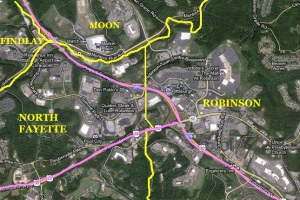
Driving around in this area can give you a complex, especially if you need help. Knowing where you are can be a challenge, as the line between Robinson and North Fayette Townships basically divides the interchange, as well as the parking lot of Lowe's, just to the south.
If you happen to be on the Parkway or one of the on or off ramps (highlighted in pink), there's a bonus - law enforcement on limited access highways such as I-376 is the responsibility of the Pennsylvania State Police.  Credit: Google Maps / John Linko

Waterworks
The Waterworks - How Not to Do It
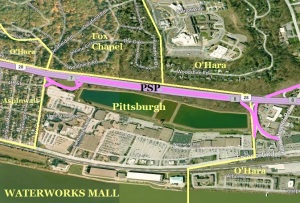
A lot of people think that when they're shopping here that they're in Fox Chapel or O'Hara Township - heck, even the company that built the place thought so.
Surprise - the mall, adjacent UPMC St. Margaret Hospital, and the Pittsburgh Water Plant across Freeport Road is actually a somewhat solitary outpost of the City of Pittsburgh, surrounded by the above communities, as well as Aspinwall. The State Police are responsible for nearby Route 28.
The associated traffic, crime and other impacts, without any say in planning or sharing in any of the tax revenue that the City enjoys, was something that had these neighboring towns bristling a bit when the complex was first opened.
Whether or not the situation has improved is unknown, but one thing appears certain - cooperation and coordination didn't appear to be a priority from the start.  Credit: Bing Maps / John Linko


The Waterfront
The Waterfront - Making the Best of It
In contrast, redeveloping the land that hosted the historic, mammoth Homestead Works could have been a significant challenge for the three towns that hosted the steel plant. But as Wikipedia notes, "The Waterfront was predominantly a private investment, although there was a tax increment financing of approximately $25 million approved by three separate municipalities, one county, and one school district, a notable accomplishment".
While the complex's sprawling size and lack of pedestrian walkways in many places makes getting around it a little tough, there appears to be a commitment by the towns who benefit from it's operation to keep it safe and attractive to residents across the region.
The complex employs private security that interfaces regularly with the three municipal police forces. Additionally, officers from those departments provide dedicated patrol of the entire complex during peak periods - without regard for jurisdictional boundaries.
Munhall still maintains its own dispatch center, but the level of cooperation between them and neighbors Homestead and West Homestead remains good. It's not perfect (what is?), but it's a step in the right direction.  Credit: Bing Maps / John Linko